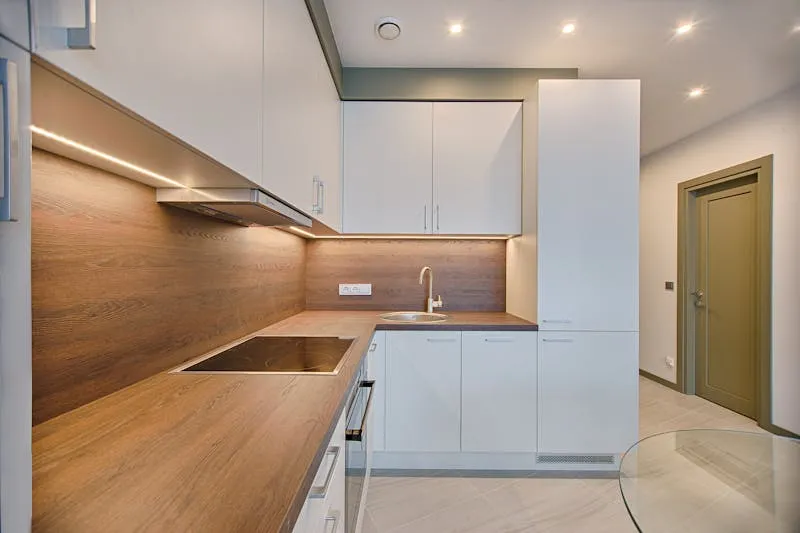
When I moved into my 300 sq ft London flat — second floor in Hackney, no lift, ceiling beams and debatable charm — I spent the first week playing Tetris with cardboard boxes. The sofa wouldn't fit through the door. The dining table swallowed half the living room. And my boyfriend, who showed up with "just two suitcases" (translation: seven boxes of vinyl records and an amplifier), looked at me as though I were the space problem.
Two years, forty YouTube tutorials and a frankly indecent number of IKEA trips later, that 300 sq ft flat became a place where visitors walk in and say "it's surprisingly big in here!" It's not magic — it's method. And here are the fifteen tips that genuinely made the difference. Not the generic advice you read everywhere ("declutter!" — cheers, Captain Obvious) but concrete solutions, tested in real life, on a real budget.
Tips 1 to 3: Think vertical, not horizontal
In a small space, floor area is currency. Every square foot on the ground is gold — and yet we leave walls desperately bare above head height. It's THE first mistake, and the one that transforms everything when you fix it.
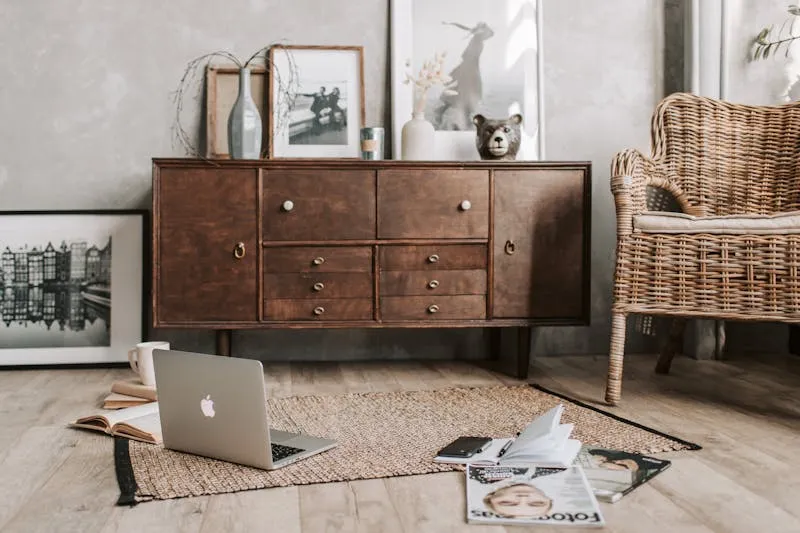
Tip 1 — Floor-to-ceiling shelving
Shelves that stop at head height are a monumental waste in a small flat. Take them all the way up. The top 40 cm serves for things you rarely need — suitcases, archives, Christmas decorations — but it's free storage you didn't have.
The IKEA Billy stands 237 cm tall in its XL version. Add a Billy extension (£30) and it reaches the standard 250 cm ceiling. For roughly £80 total, you've got an entire wall of storage. It's probably the best price-per-cubic-foot ratio on the market.
Kristina's tip: The top 30 cm under the ceiling are too high to reach easily. Invest in a small design step stool (IKEA Bekväm, £12) that stores flat against a wall. It changes everything — no more excuses for not using that top shelf.
Tip 2 — Over-door storage
Above every door there's 30 to 50 cm of unused space. A simple shelf fixed above the frame creates invisible storage nobody notices. In my flat, I've got shelves above the bathroom door (guest towels) and the bedroom door (spare duvets). Ugly? No — because with wicker baskets or matching boxes, it becomes a design feature.
Tip 3 — Hooks and pegs, everywhere
Hooks are the unsung heroes of small-space living. Behind the front door: bags and coats. Behind the bathroom door: towels and dressing gown. In the kitchen: tea towels, utensils, mugs. On the side of a cabinet: headphones, handbag.
The key: adhesive hooks (Command 3M) to avoid drilling in a rented flat, or design pegs if you own the place. A pack of 10 Command hooks costs £6 and can literally give you the equivalent of an extra cupboard.
Tips 4 to 6: Furniture that works double
In a small flat, every piece of furniture must justify its presence. If an object has only one function, the question is: can it be replaced by something that does two?
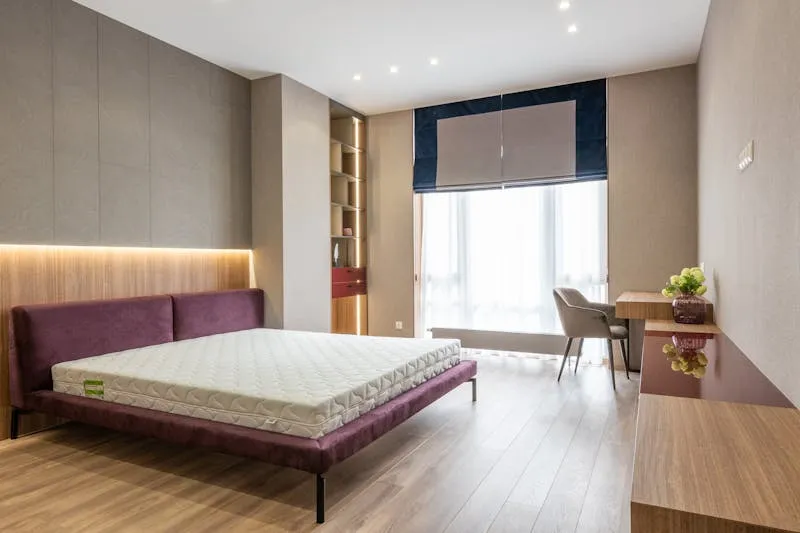
Tip 4 — The sofa bed, but the right one
Let's be honest: 90% of sofa beds are instruments of torture. The mattress is 8 cm thick, a metal bar digs into your back, and the mechanism breaks after a year. But glorious exceptions exist:
- The click-clack: more comfortable than the traditional pull-out because the mattress doesn't fold in the middle. IKEA Nyhamn or Lycksele models
- The convertible with a proper mattress: Made.com, Habitat or John Lewis models with 14 cm mattresses. Pricier (£400-£1,000) but you genuinely sleep on it every night
- The Japanese futon: the radical solution — a floor mattress you roll up each morning. Sounds extreme but it's the most honest answer for truly tiny spaces
Tip 5 — The wall-mounted fold-down table
A fixed four-person table takes 0.8 to 1.2 m² of floor — roughly 3-4% of a 300 sq ft studio. That's enormous for furniture you use two hours a day. A wall-mounted fold-down table (IKEA Norberg or Norbo, £25-£50) folds flat against the wall when not in use. You reclaim the space instantly.
The alternative: the console extending table. Folded, it's 40 cm deep — perfect as a hallway console. Unfolded, it seats 4 to 6. The Goliath models (£400-£650) are the Rolls-Royce of the category, but more affordable versions exist at Habitat or Made.com.
Kristina's tip: If you work from home, the wall-mounted fold-down table doubles as a desk. Add a wall shelf 10 cm above it for your screen, and you've got a proper workspace that vanishes completely in the evening.
Tip 6 — Storage ottomans and bench boxes
The storage ottoman is the most underrated piece of furniture in a small flat. It serves as seating, an occasional coffee table, a footrest AND storage. A 40 x 40 cm storage ottoman holds the equivalent of two drawers — blankets, magazines, toys, chargers, all the daily clutter disappears inside.
Same logic for the hallway storage bench: you sit down to put on shoes, and the chest underneath stores shoes, reusable bags, umbrellas. Two functions, one piece of furniture, one footprint.
Tips 7 to 9: Optical illusions that change everything
You can't make your flat bigger — but you can trick the brain into thinking it is. These three techniques work every time, and they're often free or very cheap.
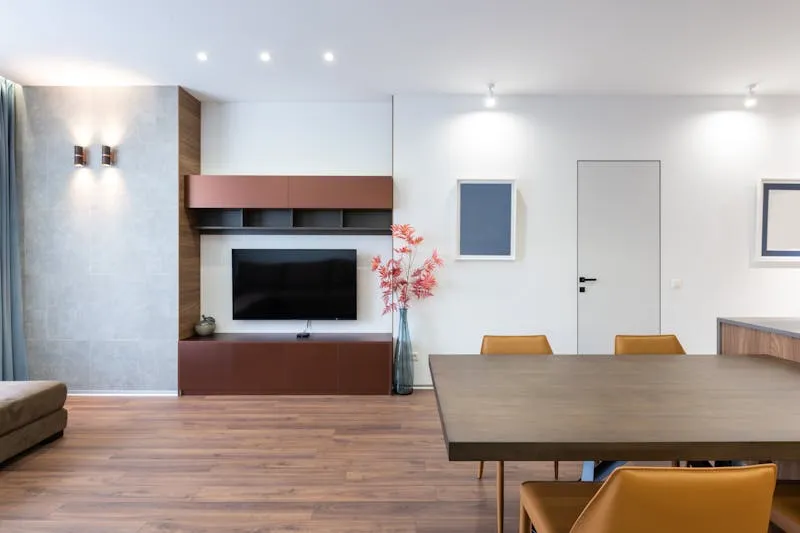
Tip 7 — The strategically placed large mirror
A mirror facing a window visually doubles both the natural light and the room's depth. This isn't a home-magazine myth — it's optical physics. The IKEA Hovet mirror (78 x 196 cm, £40) has become a small-space classic in London flats. Lean it against a wall, facing or at 90° to a light source, and watch the transformation.
Mirrors also work in narrow corridors (they "double" the width), above a sideboard (they create depth) and in the bathroom (obviously). The only mistake: placing one opposite a dark wall or a cluttered corner — it reflects the ugly too.
Tip 8 — Light colours (but not just white)
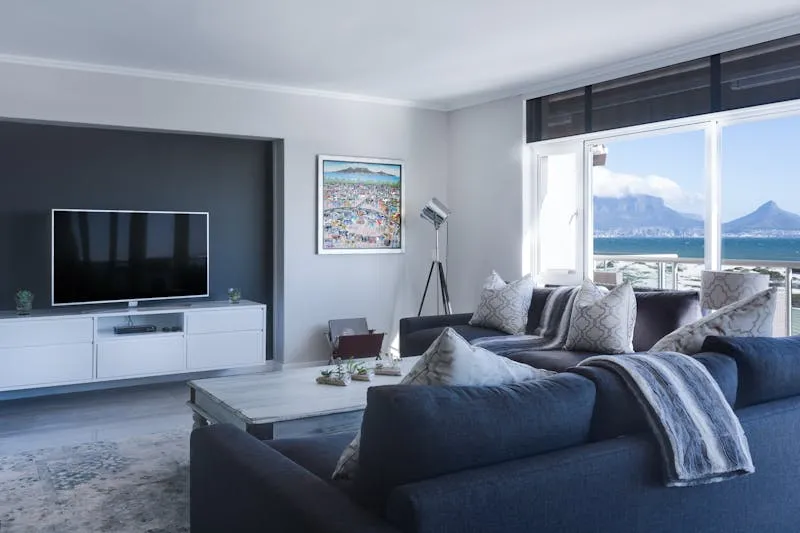
Light colours reflect light and visually "push back" walls. That doesn't mean everything must be clinical white (the hospital look isn't the goal). Off-white, cream, pearl grey, blush beige, glacier blue — all work. The point is keeping walls in light tones.
And colour? Through accessories. Cushions, throws, prints, vases, plants — they bring personality without visually shrinking the space. And when you tire of a colour, you swap the accessories instead of repainting.
Watch out: A dark accent wall can work in a small space — provided it's the far wall (it "recedes") and not a side wall (it "advances" and narrows). If you want to dare, do it on the wall furthest from the entrance.
Tip 9 — Uniform flooring
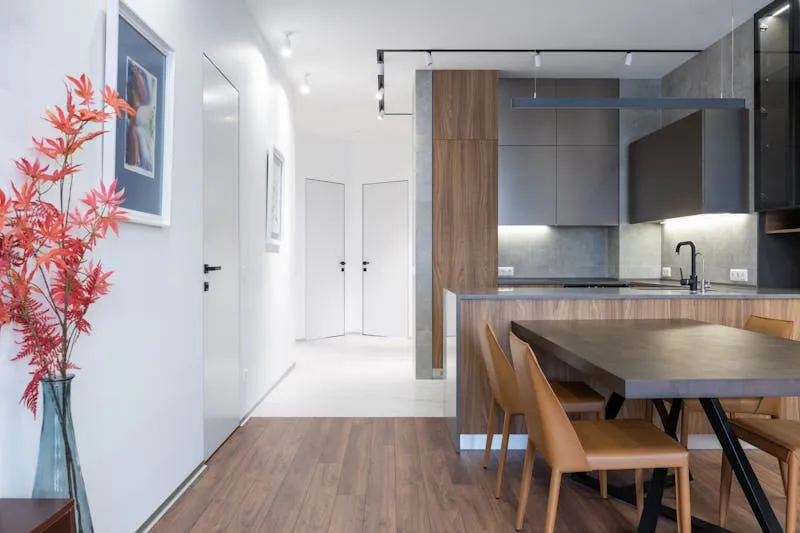
Every change in floor covering creates a visual "border" that chops up the space. In a small flat, one continuous floor material throughout (hardwood, vinyl or tile) makes everything feel larger. If you've got tiles in the kitchen and wood in the living room with a threshold strip between them, it's a constant visual reminder that your kitchen is "separate" — and therefore small.
Same logic for rugs: one large rug covering 80% of the visible floor is more enlarging than three small rugs scattered about. Small rugs fragment; a large one unifies.
Tips 10 to 12: The tiny but functional kitchen
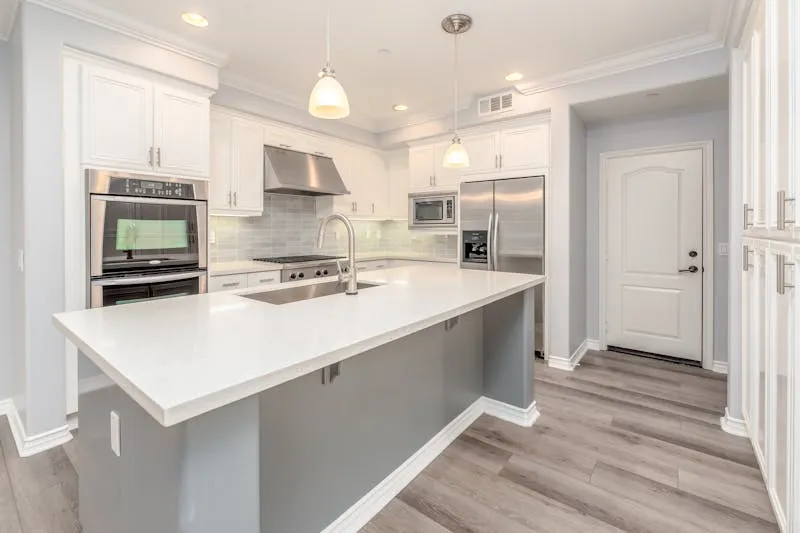
The kitchen is often the most sacrificed room in a small flat. Yet it's where optimisation has the greatest impact — because a poorly organised kitchen bleeds into the living room, the worktop, the table… and your sanity.
Tip 10 — The magnetic splashback
Stick a magnetic sheet (or a simple painted steel plate) on your splashback. With magnets, you attach: a magnetic knife rack, magnetic spice jars, a timer, tea towels (with a magnetic clip), small baskets. You free up your entire worktop — which, in a kitchenette, is sometimes 60 cm long.
The full kit (magnetic sheet + accessories) costs £30-£60. The return on investment is instant: a clear worktop is a kitchen that works.
Tip 11 — Inside the cupboard door
The inside of kitchen cupboard doors is dead space that almost nobody uses. A door organiser (£15-£25) can hold: cling film, foil, spices, pan lids, cleaning products. It's the equivalent of an extra drawer — without adding any furniture.
Tip 12 — Stackable utensils
In a small kitchen, standard utensils are your enemies. Pans with detachable handles (Tefal Ingenio, £40-£65 the set) nest like Russian dolls and take up three times less space. Stackable bowls, chopping boards that store vertically, nesting measuring sets — every small storage gain counts when you have two cupboards total.
Kristina's tip: Audit your kitchen with the "six-month rule." If you haven't used something in six months, it goes. That mandoline you used once for a gratin in 2022? Gone. The toastie maker taking up 30 cm of cupboard? Gone. Be ruthless — the space you free is worth more than the item you're keeping "just in case."
Tips 13 to 14: Sleeping big in a small space
Tip 13 — The loft bed (the radical solution)
A double bed takes roughly 30 sq ft of floor space. In a 270 sq ft studio, that's 11% of your total area. A loft bed gives those 30 sq ft back underneath — for a desk, a sofa, a wardrobe, or all three at once.
Today's versions bear no resemblance to the wobbly loft bed from your uni halls. Sturdy metal models (IKEA Storå, £180) support 150 kg and are stable. Bespoke solid-wood versions (carpenter-made, £600-£1,500) are proper pieces of furniture in their own right.
The caveat: ceiling height. You need a minimum of 180 cm between the mattress and the ceiling to sit up in bed, and 120 cm below for a comfortable desk. That means you need at least 3 m floor-to-ceiling for a truly liveable loft bed. Below that, it's possible but a touch claustrophobic.
Watch out: If renting, check your tenancy agreement — some landlords prohibit loft-bed structures. And in older buildings, check the fixing wall's solidity. A loft bed badly anchored into plasterboard is a disaster waiting to happen.
Tip 14 — The ottoman bed
If a loft bed isn't possible (low ceiling, restrictive lease, vertigo), the ottoman bed is the alternative. The mattress lifts on gas struts, revealing a storage space 30-40 cm deep across the entire bed surface. For a double bed, that's roughly 0.8 m³ of storage — the equivalent of a large chest of drawers, UNDER your bed.
The most practical models have hydraulic struts that lift the mattress one-handed. IKEA Malm, Argos and Dreams offer them between £250 and £500. Compared to the price of a chest of drawers plus the floor space it occupies, it's a winning calculation.
Tip 15: The golden rule that sums it all up
Here's the only rule that matters in a small flat: one thing in = one thing out. Not tomorrow. Not "when I get round to it." Immediately.
This isn't extreme minimalism — it's physics. Your flat has a maximum capacity, and if you exceed it, clutter wins. Every purchase is a choice: is this object worth more than the space it takes? In a large flat, the question doesn't arise. In 300 sq ft, it arises every single time.
And the good news: this constraint makes your choices better. You buy less, but better. You keep what genuinely matters. And paradoxically, you feel less cramped in a well-planned 300 sq ft than in a cluttered 650 sq ft.
Kristina's tip: Keep a permanent "outgoing" box in a corner. Every time you think "meh, I don't use this any more," in the box it goes. When the box is full, it goes to charity (British Heart Foundation, Gumtree free section, friends). It makes decluttering painless — no big Marie Kondo session, just a continuous flow.
The 5 mistakes that shrink a flat
Good ideas matter, but the mistakes to avoid make just as much difference. Here are the five I see most often — and committed myself before understanding.
- Oversized furniture: an XXL corner sofa in a 300 sq ft flat is like parking a Range Rover in a Smart car space. Measure BEFORE buying — always. A two-seater is enough for most studios, and a three-seater is the absolute maximum for a one-bed
- Too-short curtains: curtains that stop at the window edge visually squash the room. Hang them from the ceiling (or just below) and let them drop to the floor. The eye reads "the room is tall" — and tall = spacious
- Dark furniture en masse: one dark piece is a focal point. Five dark pieces in a small space is a cave. If all your furniture is dark, add light trays, runners or objects on top to balance
- Doors that stay shut: every closed door creates a visual box. In a small flat, leave open the doors you can — bathroom and loo excepted, obviously. Visual flow enlarges the space
- A single central light: one ceiling pendant creates shadows that "close" the corners. Multiply your sources: table lamp, fairy lights, LEDs under high cabinets. A room lit in its corners feels more spacious
Watch out: Don't blow your budget on "storage solutions" that take up space themselves. An 80 cm-wide drawer unit is 80 cm less floor space. Sometimes, decluttering costs £0 and frees more space than any organiser ever could.
The action plan for your budget
You don't need to do everything at once. Here's a logical progression that maximises impact at every stage:
Phase 1 — The declutter (free)
Before buying anything, do the big sort. Every object passes the test: "Do I use it? Do I love it?" If the answer is no to both, it goes. This step alone can free 20-30% of your storage space. And it's free. Start with the bathroom (smallest room, quickest to sort), then the kitchen, then clothes.
Phase 2 — Under £40 (instant wins)
- Command adhesive hooks (pack of 20): £12
- Cupboard door organisers (x2): £20
- Wicker storage baskets (x3): £12
Phase 3 — £40 to £150 (visible transformation)
- Large mirror (IKEA Hovet or similar): £40
- Floor-to-ceiling shelving (Billy XL + extension): £80
- Wall-mounted fold-down table: £25-£50
- Storage ottoman: £25-£40
Phase 4 — £150 to £600 (full optimisation)
- Ottoman bed: £250-£500
- Quality sofa bed: £400-£1,000
- Ceiling-to-floor curtains made to measure: £60-£150
- Magnetic splashback + accessories: £30-£60
The essential point: don't spend until you've done the declutter (phase 1) and the free or very cheap wins (phases 2-3). Often, phases 1 and 2 alone are enough to transform how a small flat feels.
Kristina's tip: Take "before" photos of every room. We adapt so quickly to our surroundings that we stop noticing the improvements. The photos remind you where you started — and that's incredibly motivating to keep going.
Frequently asked questions about small flat living
What's the single best piece of furniture for a small space?
The storage ottoman. Seriously. It combines seating, an occasional table and storage in one object that takes up a 40 x 40 cm footprint. After that, the wall-mounted fold-down table, which frees 10 sq ft when folded. The best furniture is whatever serves multiple functions — one item, two uses minimum.
Is a loft bed suitable for a couple?
Yes, provided you get a double-width model (single-width loft beds really are for one person) and your ceiling is at least 3 m high. Bespoke solid-wood versions are more stable and quieter than budget metal ones. And no, it's not "a student thing" — London interior architects install them in flats at £1,200 per sq ft.
How do you create zones in a studio without walls?
Three techniques: a rug (it visually marks a "living zone"), an open bookcase (it divides without blocking light) and a curtain on a ceiling track (it screens the sleeping area without building work). The curtain is the most flexible — open it by day for one unified space, close it at night for an intimate bedroom nook.
Do I need bespoke furniture in a small flat?
Bespoke is ideal but not essential. IKEA hacks offer an excellent middle ground: affordable prices, easy customisation, standard dimensions. A PAX wardrobe with custom internals (drawers, rails, baskets) fits almost every nook. True bespoke (carpenter-made) is worthwhile for awkward spots — under a staircase, in a non-standard angle, around a beam.
What's the worst mistake in a small space?
Buying "storage solutions" before decluttering. Every storage unit takes up space itself. If you're storing things you don't need in furniture you bought for them, you've lost twice: the money for the furniture AND the space it occupies. Declutter first, organise second.
Can a small flat be stylish or just "functional"?
Absolutely stylish. Well-planned small spaces often have more character than large ones — because every object is chosen, not defaulted to. The most beautiful interiors I've seen on Houzz and in magazines are small spaces. Constraint breeds creativity, and creativity breeds beauty.