
I was eleven, and the second drawer of my grandmother's chest of drawers was the one place in her house I was forbidden to rummage through. One Sunday in April, she opened it for me herself. Inside: twenty-three scarves folded into quarters, two pairs of kid gloves, a lipstick with no lid — and that whiff of CK One that followed her everywhere. She picked one out (navy, rearing horses, a sheen that looked almost liquid) and tied it round my neck in about four seconds. A flick of the wrist, two corners tucked in, done. I spent the rest of the afternoon in front of the hall mirror trying to copy the move. I never managed it.
For my eighteenth birthday she gave me three scarves from that drawer — the horses included. Ten days ago, digging out my spring things, I finally did something I'd never once thought of doing: I read the labels. The horse scarf, the one I'd worshipped since I was eleven? "100% polyester". The little pale-green square I'd always found a bit dull? "100% silk", with a hem rolled by hand so finely it looks like piping. The third had no label at all (someone had snipped it off, probably because it itched). I burst out laughing, sitting on the floor of my Hackney flat with a scarf in each hand. The shine had fooled me — for twenty-two years.
You've probably got a scarf like that: the one you assume is precious because it gleams, and never dare wear in case you ruin it. Yet April is exactly the month to get it out. Too chilly for a bare neck, too mild for a wool scarf — this is silk-square season. So here are the twelve knots I actually wear, sorted by where they go (neck, hair, handbag), followed by how to tell whether your scarf is silk at all. Because a lovely knot on slippery polyester is a lovely knot wasted.
Which scarf size for which knot?
Size decides half of what you can do with a scarf. The benchmark remains the big square: Wikipedia's entry on Hermès gives the house's carrés as 90cm by 90cm. Below that, the silk scarves page of Hermès's UK shop also sorts its squares into "Scarves 70" and "45 scarves", each named after its side in centimetres. Then come long skinny scarves — every size with its own favourite knots.
| Size | Rough guide | Knots it does best |
|---|---|---|
| Large square | 90cm a side | Cowboy triangle, pussy bow, double wrap, headscarf |
| Medium square | around 70cm a side | Side knot, headband, wrapped bun |
| Small square | from about 45cm a side | Short neck knot, ponytail ribbon, handle knot |
| Skinny scarf | long, narrow strip | Wrapped handle, hair, wrist |
If you only buy one, make it medium. It does the most things well — big enough for your neck, small enough for your hair and your bag. The large square is more dramatic, but it takes practice not to end up looking gift-wrapped under the chin. One printed square multiplies the outfits in a minimalist yet stylish capsule wardrobe.
The two basic folds behind every knot
All twelve knots in this guide start from one of two folds. Master those two moves and everything else is a variation.
- The triangle. Lay the square flat, wrong side up, and fold one corner onto the opposite corner. That's it — the basis of the cowboy triangle, the headscarf and the scarf-ring look.
- The band. Start from the triangle, fold the point up to the long edge, then keep folding the band over itself to the width you want (two fingers for a discreet knot, four for a headband). Smooth each fold with the flat of your hand — not the iron, a pressed-flat fold kills the drape. The band covers almost everything else.
5 ways to tie a silk scarf around your neck
The neck is the scarf's home turf — and where people most often get the volume wrong. Here are my five, from most relaxed to most polished.
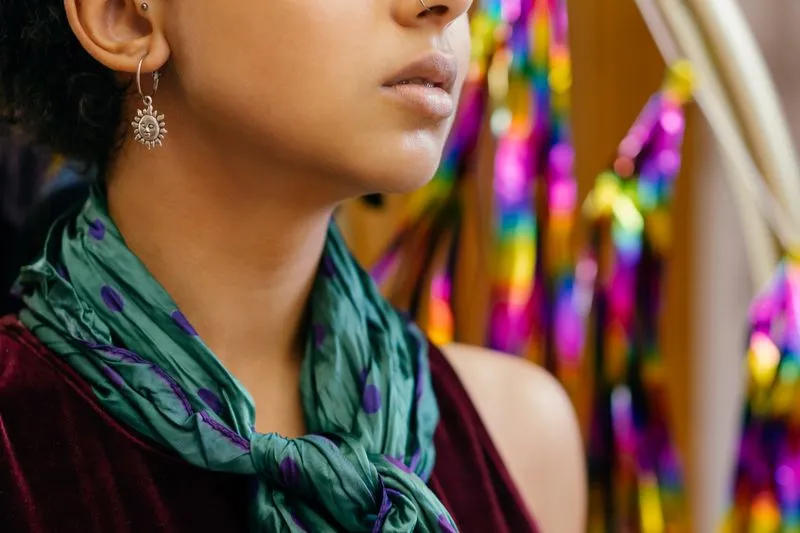
1. The cowboy triangle
- Fold the square into a triangle and put the point at the front, on your chest, ends towards the back.
- Cross the ends behind your neck and bring them round to the front.
- Knot them under the triangle — or let them hang at the sides.
The simplest of the twelve, and the most springlike. A large square over a fine jumper or a denim jacket works every time. The trap: a triangle so long it hangs over your stomach. Pull it up until the point sits at your collarbone.
2. The little side knot
- Fold a medium or small square into a narrow band (two fingers).
- Lay it across the back of your neck, ends at the front.
- Tie a knot, then a second on top, slightly off to one side.
- Leave two short tails showing, points down.
It's the air-hostess knot, minus the formality. Over a shirt with the top button undone or a fine roll-neck, it looks crisp with zero effort. Push it properly to the side: dead centre, it reads as uniform.
3. The pussy bow
- Fold a large square into a wide band (four fingers).
- Drape it round your neck, one end longer than the other.
- Tie a loose single knot at the base of your neck.
- Make a loop with the short end.
- Wrap the long end round it and push it through the gap — exactly like tying a shoelace.
- Fluff out both loops and let the ends fall over your chest.
The pussy bow is the knot for the office and for interviews that matter. With a blazer, it stands in for jewellery. Pick a matt silk with some grip: on a very glossy, slippery silk, the loops sag before lunch.
4. The double wrap
- Fold a large square into a medium band.
- Place the middle of the band at your throat, ends towards the back.
- Cross them behind your neck and bring them back to the front.
- Tie a small tight knot, then tuck it (tails and all) under the wrap.
My favourite for nippy April mornings: it keeps your throat warm without the bulk of a winter scarf, and nothing sticks out. Perfect under a trench. If your neck is on the short side, keep the band narrow — a chunky wrap swallows you.
5. The scarf-ring drape
- Fold the square into a triangle, point at the front, and gather both ends in front of you at chest height.
- Slide them through a scarf ring or any plain ring.
- Push the ring up to where you want it and let the points float.
No knot, so no creases in good silk. The ring becomes the statement piece: to pick one that works with the print, have a look at our guide to choosing, matching and wearing jewellery. An old costume ring that's too big for your fingers does the job nicely (yes, I've tried it).
4 ways to wear a silk scarf in your hair
In your hair, silk has one advantage over cotton: it glides without snagging. It also has one obvious drawback — it glides. With my fine hair, I've learnt a few tricks (two kirby grips crossed in an X at the temples and a mist of texturising spray through the lengths).

6. The headband
- Fold a medium square into a band three or four fingers wide.
- Place the middle at the top of your forehead, along the hairline.
- Take the ends under your hair to the nape of your neck.
- Double-knot — tails loose or tucked in.
Seventies version: tie the knot on top of your head, slightly off-centre, tails pointing up. More playful, more noticeable.
7. The ponytail ribbon
- Tie your ponytail with a thin elastic.
- Fold a small square (or a skinny scarf) into a narrow ribbon.
- Wrap it round the elastic to hide it.
- Tie a bow, like a shoelace, and let the ends fall into your hair.
No hair knot is quicker to get right, and it lifts an everyday hairstyle most. Chiffon floats prettily; twill makes a crisper, more graphic bow.
8. The headscarf
- Fold a large square into a triangle.
- Lay it over your head, point towards the nape, long edge along your forehead.
- Bring both ends under your chin and knot them.
The convertible-and-sunglasses look — which also earns its keep on windy, drizzly days. For a less prim version, cross the ends under your chin and tie them at the back of your neck: it frees your neck and looks more current. I wear it when travelling, unwashed hair and all (a headscarf forgives everything).
9. The wrapped bun
- Make a low bun and pin it firmly.
- Fold a medium square into a wide band.
- Place the middle of the band under the bun and wrap the ends around it, crossing them.
- Knot underneath and tuck the points inside.
This is the knot for dinners and daytime weddings: your bun becomes an accessory in its own right. It holds better on a slightly messy bun than on one slicked down with gel.
3 ways to tie a silk scarf on a handbag
Tying a scarf to your bag is the easiest way to wear a print without putting it near your face. And if your bag is one of the greats, the story behind fashion's most legendary handbags tells you where it came from. A plain bag, a square that picks up one of its colours, and your whole outfit shifts.
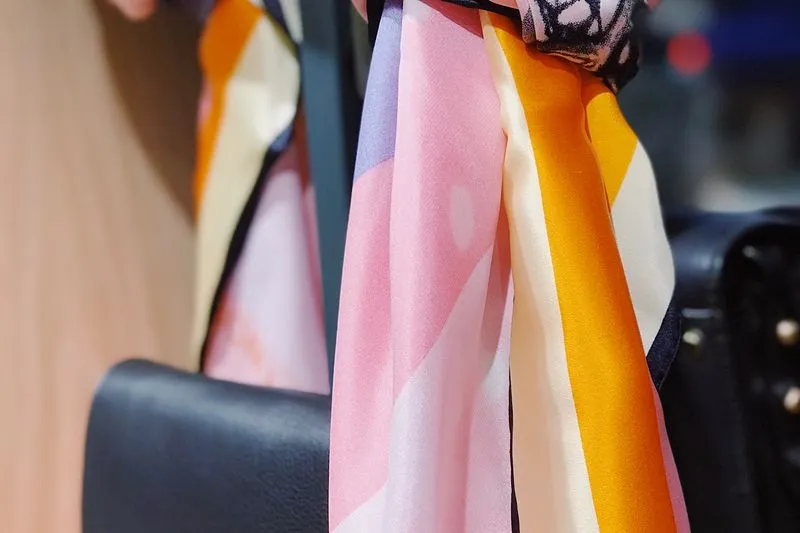
10. The handle knot
- Fold a small square into a band two fingers wide.
- Wrap it round the handle, near where it joins the bag.
- Tie a simple knot, then a bow, like a shoelace, and let the ends flutter — they swing as you walk.
Put this knot on one side only, never in the middle of the handle (where your hand rests, silk gets grubby within days).
11. The wrapped handle
- Take a skinny scarf, or a large square folded into a very narrow band.
- Knot one end at the base of the handle.
- Wind the band in a tight spiral along the handle, each turn overlapping the last slightly.
- Smooth each turn with the flat of your hand, without pulling.
- Knot the other end at the opposite base and tuck the point under the last turn.
The spiral dresses up a tired leather handle, and you can swap it in two minutes. Choose a silk thin enough to lie flat.
12. The bow on the ring
- Fold a small square into a medium band.
- Thread it through the metal ring that joins the handle to the bag.
- Tie a simple knot, then a neat, symmetrical bow.
- Tuck the ends into the knot for a clean finish.
The bow suits structured bags and clutches. On an everyday tote, it replaces a jangly keyring charm — minus the noise.
Why silk scarves slip, and how to make them stay put
Silk slips because it's smooth: that's the whole joy of wearing it, and the whole difficulty of tying it. A badly crossed knot works loose within an hour. Three fixes, in order of how well they work.
- The reef knot. For a double knot, cross right over left, then left over right. The ends come out parallel and the knot lies flat. Cross the same way twice and you get a granny knot that twists — then undoes itself.
- The hidden pin. A small safety pin, slipped into a fold inside the knot, stays invisible and holds all day. Pin through the fold, never through a single stretched layer.
- The right base. On knitwear or cotton, your scarf stays put far better than on a satin blouse. Silk on silk, everything slides.
How do you spot a real silk scarf?
You spot a real silk scarf by its label first, and only as a last resort by flame. In that order. Touch and shine fool everyone — me included, with my rearing horses.
The fibre label: your first judge
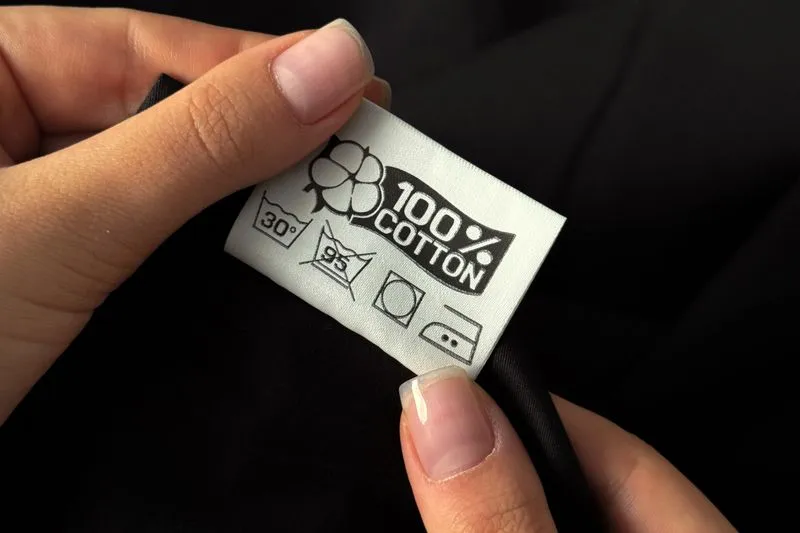
In the UK, a fibre-content label isn't optional — Article 14 of the UK version of the textile fibre regulation requires textile products to be labelled or marked with their fibre composition whenever they're sold.
The rules on fibre names are just as strict. The same regulation lists the only fibre names a label may use — and its Annex I defines silk as "fibre obtained exclusively from silk-secreting insects". No insects, no silk. If the label says "100% silk", the seller is putting that in writing. If it says "70% silk, 30% polyamide", it's a blend — not necessarily a bad buy, but not the same price.
The wording around the numbers is regulated too. Article 7 of the same regulation states that "Only textile products exclusively composed of the same fibre may be labelled or marked as '100 %', 'pure' or 'all'", with a tolerance of up to 2% of stray fibres when they're technically unavoidable. In plain English: "satin", "silky" and "silk-feel" are not fibres. Satin is a weave (you get silk satin and polyester satin). A scarf sold as "satin" with nothing else on the label? Usually the second kind.
And when there's no label at all? On a new scarf, walk away. On a vintage find, it's more complicated — the label may have been cut off thirty years ago, like on my third scarf. That's where the clues take over, limits and all.
Touch and shine: two false friends
No, shine proves nothing. A satin-finish polyester can gleam more than silk, and silk crêpe is almost matt. My own test (zero scientific value, I'll admit): I hold the scarf scrunched in my hand for ten seconds or so. Silk warms up to skin temperature quickly; polyester stays cool for longer and has a slightly "plasticky" rustle when you crumple it. A clue, never proof — I've got it wrong twice.
The burn test, done carefully
For a square with no label, there's the single-thread burn test. Museums use it too: the fibre identification wiki of the American Institute for Conservation's Textile Specialty Group lists the smells to look out for — burning hair for protein fibres (silk among them), burning paper for cotton and viscose, plastic-like smells for synthetics. The same document notes that most textile conservators identify fibres under a polarised light microscope, and that burn tests are used as corroborating evidence. Remember that: the test points you in a direction, it doesn't settle the matter.
The procedure it describes is simple: a sample at least 1cm long, held in tweezers, moved slowly towards a small flame. You watch the thread, you sniff, then you touch the cooled end to judge how hard it is. And — the step everyone skips — you compare with the same test on a fibre you already know. That's what I did, without pulling anything: a loose thread already hanging from a frayed corner of my pale-green square labelled "100% silk" as the reference, and another dangling from the edge of the unlabelled one. Same burnt-hair smell, same soft end that crumbled under my finger. Silk, then (almost certainly).
Momme weight: what the number tells you (and what it doesn't)
Momme (written "mm") measures how dense a silk fabric is. It's an old silk-trade unit that some brands print on their product pages. Wikipedia's entry on units of textile measurement defines it as the weight in pounds of a piece of silk 45 inches wide and 100 yards long. Do the maths: one pound (453.6g) spread over roughly 104.5 square metres gives about 4.34g per square metre for each momme.
The same entry lists the usual ranges for each weave. Here they are, with what they mean for a scarf.
| Silk weave | Usual momme | What it's like as a scarf |
|---|---|---|
| Gauze | 3 to 5 | Almost see-through, more veil than scarf |
| Organza | 4 to 6 | Crisp and airy, not made for tight knots |
| Chiffon | 6 to 8 | Floaty and light, perfect in your hair in spring |
| Habutai | 5 to 16 | Soft and supple, the staple of entry-level squares |
| Crêpe de Chine | 12 to 16 | Matt, slightly grainy, holds a knot without slipping |
| Charmeuse | 12 to 30 | Glossy on one side, very slippery — gorgeous but temperamental |
The entry's rule of thumb: the higher the momme, the more durable the weave. For a scarf, though, heavier isn't automatically better. Dense silk makes a bulky knot at the throat; 6-momme chiffon takes off at the first gust. It depends what you want it for.
Silk twill — the diagonal weave of the classic big squares — isn't in that table. For twill, ask the seller for the momme directly. My view (and it's only mine): a brand that knows its momme and tells you without being chased is a brand that knows its craft.
The hand-rolled hem, the signature of a good silk square
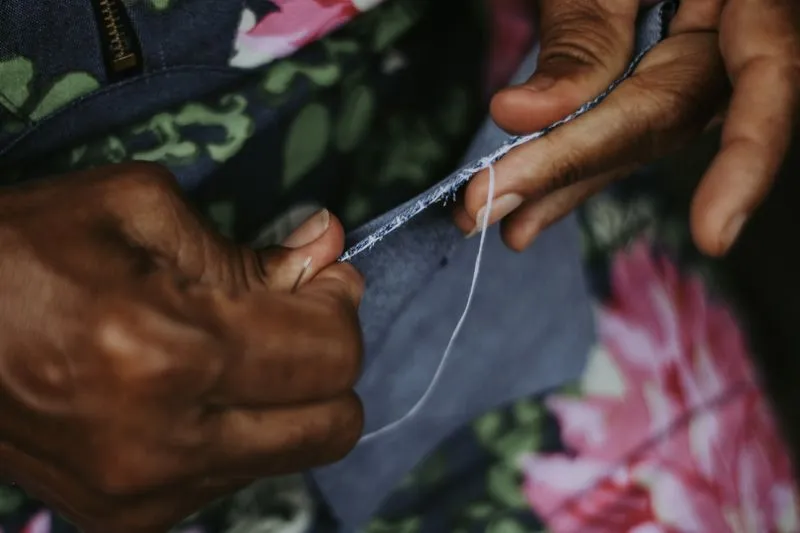
A rolled hem is the edge of the scarf rolled over on itself and sewn with tiny stitches. Done by hand, it makes a small, round, soft ridge that catches the light. Done by machine, it's flat, perfectly even and often topstitched.
At Hermès, the gesture has its own workshop. The Holding Textile Hermès page on its confection expertise explains that its artisans hand-stitch the hems of silk and cashmere pieces "in French roulottage style, i.e. the edge of the fabric is rolled from the back towards the front". Flip your square over: with a French-style roll, the ridge shows on the printed side.
British scarf-making has its own fine examples. At the V&A, a 1953 silk panel by the British scarf house Jacqmar, printed with a portrait of Elizabeth II in Coronation year, is catalogued in the museum's collections as a "Plain weave with hand-rolled hem on four sides". Seventy-odd years on, that detail is still what separates a square made to last from one made to sell.
Checking a hem in thirty seconds
- Pinch the edge between two fingers. A hand-rolled hem has body, like fine cord; a machine hem is flat.
- Look closely at the stitches and the roll. By hand the stitches are small, spaced out, a touch uneven — by machine they form one continuous, immaculate line. Rolled towards the front is the French style Hermès describes.
- Look at the corners. A hand-rolled corner is rounded and soft, never sharp or stiff.
Washing, ironing and storing a silk scarf
Unless its care label says otherwise, a silk scarf gets washed by hand, drip-dried in the shade and ironed at a moderate setting. Trouble is, plenty of squares (vintage ones especially) don't have a care label at all.
Hand-washing
The care-symbol guide from GINETEX, the international association for textile care labelling, has two hand-wash symbols: at room temperature, around 20 to 30°C, and at 40°C maximum. Either way: a fine detergent dissolved in plenty of water, and the textile left to float and agitated gently. Above all, don't rub, pull or wring. Rinse well, press the water out carefully, and never leave a coloured piece lying around wet.
For drying, the same guide lists silk among the delicate textiles to drip-dry on a line in the shade. So no tumble dryer, no radiator. I dry mine on a hanger in the bathroom with the window open a crack.
Ironing
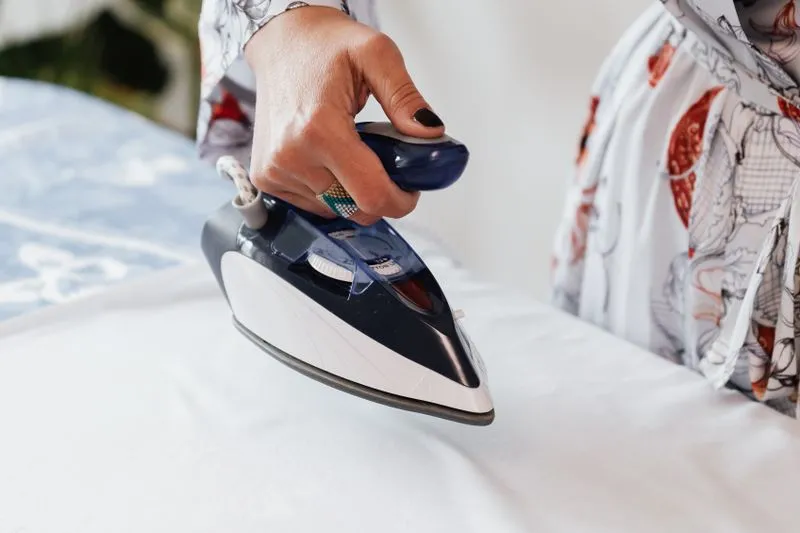
According to GINETEX, the moderate-temperature iron symbol matches the "wool/silk/polyester/viscose" setting: a soleplate at 160°C maximum, under a slightly damp pressing cloth, without pressing hard. I always iron on the reverse — and I stop short of the rolled hem, because a hand-rolled edge squashed by an iron loses its shape.
Storing
Rolled rather than folded, out of direct light, with nothing heavy on top. A square left folded in quarters for years keeps the marks (mine still has them). And I spray perfume on my skin, never on the silk — on a pale square, I'd rather not find out.
Buying a vintage silk scarf: a four-step checklist
Charity shops, car boot sales and resale apps are full of squares — and full of shiny polyester passing itself off as silk (my rearing horses being living proof). Before you pay, four checks.
- The label. Fibre content first, brand second. No label? You're buying a gamble — so pay gamble prices.
- The hem. Pinch the edge, look at the stitches, check the corners: a hand-rolled hem has body and slightly uneven stitches.
- The light. Hold the scarf up to a window and look for pulled threads, tiny holes and paler patches (often sun fading).
- The marks. A musty smell comes out in the wash; a ring of perfume or foundation on pale silk, far less reliably.
Very recognisable prints at rock-bottom prices deserve a second look: a label is easier to copy than a finish. And to sort what will date from what will last, our method for adapting runway trends to everyday life works just as well on scarves.
Frequently asked questions
How can I tell if my scarf is silk without a label?
Without a label, no single clue proves it's silk. The most reliable check at home is burning a single thread of the fabric, teased out from the edge under the hem (not the hem stitching): a burnt-hair smell suggests a protein fibre such as silk. Always compare with a thread of known silk. Museum conservators use it alongside the microscope: it's a clue, not proof.
What momme is best for a silk scarf?
It depends on the weave and what you'll use it for. Typical ranges run from 6 to 8 momme for chiffon, 12 to 16 for crêpe de Chine and 12 to 30 for charmeuse. For a neck scarf that holds its knots, crêpe de Chine or twill beats a very glossy charmeuse; for your hair, a light chiffon is plenty.
What size scarf should I get to tie around my neck?
A 90cm square handles all the fuller knots (cowboy triangle, pussy bow, double wrap). A medium square, around 70cm, is the most versatile — neck, hair and bag. A small square, from about 45cm, ties short at the throat or on a bag handle.
How do I stop a silk scarf from slipping?
Tie a reef knot (right over left, then left over right) and slip a small safety pin into a fold inside the knot. In your hair, cross two kirby grips in an X under the scarf and add a little texturising spray to the lengths.
Can you machine-wash a silk scarf?
Only if the care label allows it. Otherwise, hand-wash it at room temperature (around 20 to 30°C) with a fine detergent, without rubbing, twisting or wringing, then drip-dry it on a line in the shade.
Is satin the same as silk?
No. Satin is a weave, not a fibre: you get silk satin, polyester satin and acetate satin. Only the fibre label tells you which — and a scarf sold simply as "satin" is usually synthetic.
Does a hand-rolled hem prove a scarf is silk?
No. The hem tells you about the finish, not the fibre. At Hermès, for instance, hand-rolling is used on silk and cashmere pieces alike. Only the fibre label tells you the material for certain.
Sources
- legislation.gov.uk — Regulation (EU) No 1007/2011 on textile fibre names, Annex I (UK version)
- legislation.gov.uk — Regulation (EU) No 1007/2011, Article 14: labels and markings (UK version)
- legislation.gov.uk — Regulation (EU) No 1007/2011, Article 7: pure textile products (UK version)
- V&A Collections — Scarf, Jacqmar, 1953
- Holding Textile Hermès — Our confection expertise
- Wikipedia — Units of textile measurement (Mommes)
- Wikipedia — Hermès (silk scarves)
- Hermès UK — Silk scarves and accessories (page as of December 2024)
- GINETEX — Care symbols (ISO 3758)
- American Institute for Conservation — Textile Specialty Group, Fiber Identification