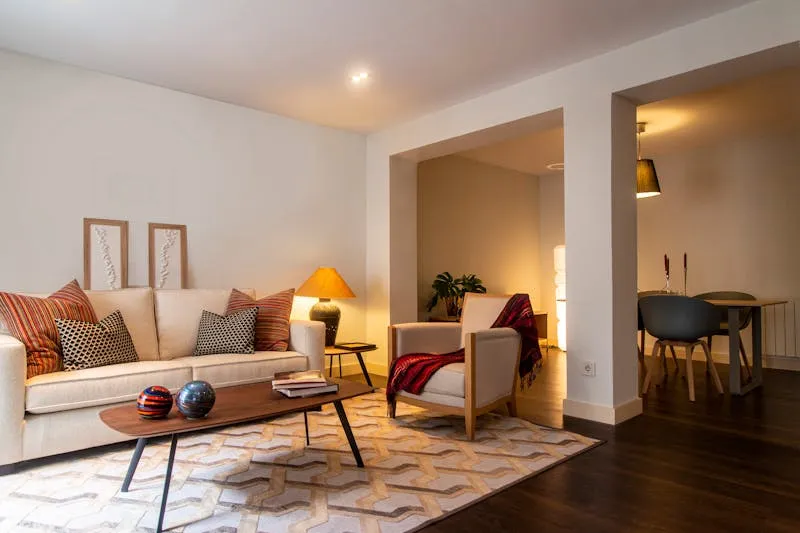
The first night in my new apartment, I hit the living room light switch and immediately understood why the previous tenant had left. A single overhead fixture — fluorescent, blue-white, merciless — illuminated every corner of the room with the warmth and charm of a hospital corridor. The beautiful parquet floors looked grey. The walls looked green. My face, reflected in the dark window, looked like it belonged in a crime drama. I turned it off after eleven seconds. I counted.
That evening, I ordered a table lamp, two warm-white LED bulbs, and a dimmer switch. Total cost: forty-seven dollars. And when I set everything up the next day, the same room — same furniture, same walls, same floor — looked like a completely different space. It looked like somewhere I actually wanted to be. That's when I understood what interior designers have been saying forever: lighting isn't part of the decor. Lighting IS the decor.
The 3 types of lighting: the foundation of everything
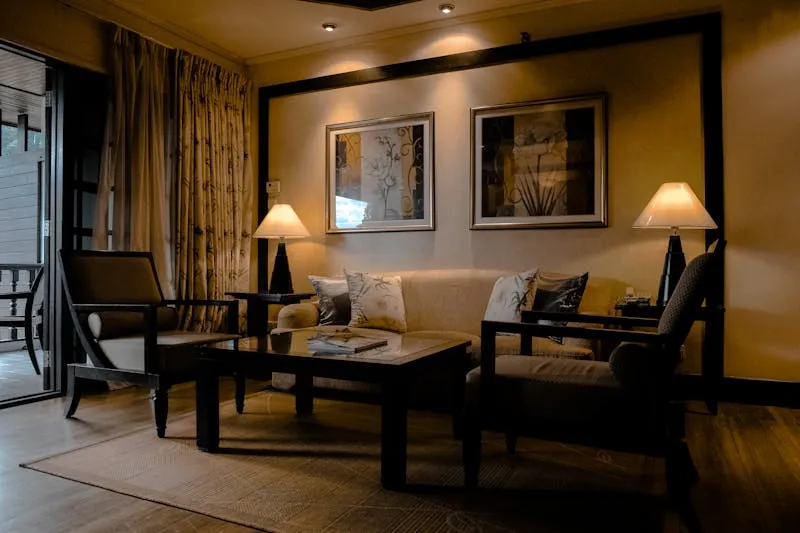
Before talking about lamps, bulbs, or aesthetics, you need to understand that lighting a room properly requires three distinct layers. Always three. Not one, not two — three. This is the foundational principle of all successful interior lighting, and it's the one that 90% of people completely ignore.
Ambient lighting (general)
This is the base layer — the light that illuminates the room evenly. A ceiling fixture, a chandelier, recessed spotlights, a track lighting system. It's the first thing you turn on when you walk in. Its role is functional: see where you're walking, identify objects, navigate the space. This layer doesn't create atmosphere — it makes atmosphere possible.
The most common mistake: relying solely on ambient lighting. A single overhead fixture, no matter how beautiful or bright, produces a flat, shadowless wash of light. It's office lighting, not living lighting. Light coming exclusively from above flattens faces, eliminates contrast, and gives any room the welcoming atmosphere of an underground car park.
Task lighting (functional)
This is targeted light for a specific activity in a specific zone. The desk lamp for working. Under-cabinet lights in the kitchen for food prep. A reading sconce above the bed. A vanity light above the bathroom mirror for applying makeup.
Task lighting should be brighter than ambient lighting — logically, it serves activities that require visual focus. But it shouldn't be blinding. The sweet spot: 2 to 3 times brighter than the room's general lighting, with the beam directed at the work surface rather than at your eyes. Opaque shades and adjustable spotlights are your best allies here.
Accent lighting (decorative)
This is the layer that gives a room its soul. LED strips behind a TV unit. Table lamps on a console. Candles on the coffee table. A picture light illuminating artwork. It's the light you don't directly "see" but absolutely feel — the layer that transforms a functional room into a space where you genuinely want to stay.
Accent lighting should be softer than the other two layers. It's what brings warmth, depth, and character. Without this third layer, a room is lit. With it, a room is alive.
Colour temperature: why your bulbs are ruining your space
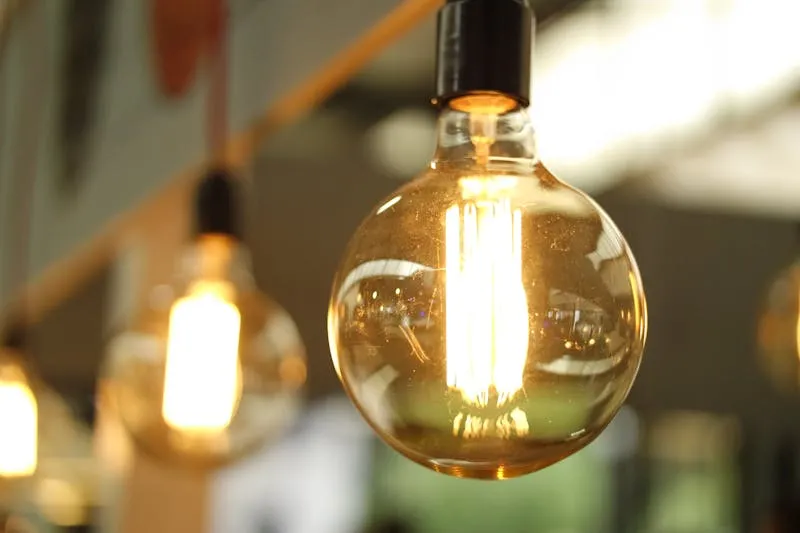
Colour temperature is measured in Kelvins (K), and it's probably the single most important — and most ignored — specification when buying a bulb. It determines whether your light reads warm (amber), neutral (white), or cool (blue-ish). And it's what makes the difference between "I want to stay here all evening" and "I need to leave this room."
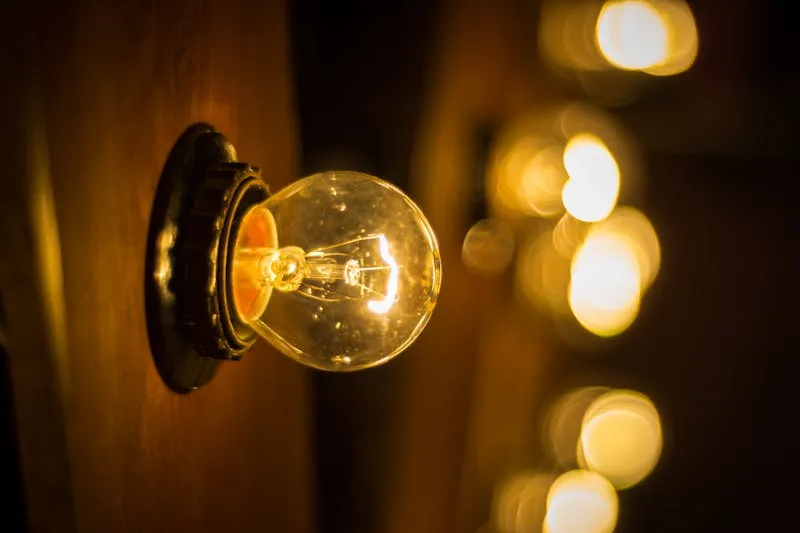
2,700K — Warm white. This is the temperature of the old incandescent bulbs we grew up with. A golden, enveloping light that flatters skin tones and creates a cosy atmosphere. It's the ideal temperature for living spaces (living room, bedroom, dining room) — any room where the goal is relaxation.
3,000K — Warm neutral. One step up. Still warm, but a little more "alive." It's an excellent compromise for mixed-use spaces (open kitchen-living room, a desk area in the bedroom). Not as cocooning as 2,700K, not as sterile as 4,000K.
4,000K — Neutral white. Task lighting territory. Clear, precise, with no warm colour cast. Suited for kitchen countertops, bathrooms (for makeup application), and home offices. Not suited at all for relaxation spaces — it stimulates rather than soothes.
5,000–6,500K — Cool white / Daylight. Clinical. This is the light of office fluorescents, parking structures, and supermarkets. Never — absolutely never — in a residential interior. If your living room is lit at 5,000K+, that's the number-one source of the vague discomfort you can't quite name. It's the bulb to replace before you buy a single new lamp.
The living room: mastering layered light
The living room is the most complex room to light because it serves multiple functions: watching TV, reading, entertaining, sometimes dining. Each activity has different lighting needs, and the goal is to transition between them without the light becoming an obstacle.
Ambient layer: a central ceiling fixture (if you have one) on a dimmer, or evenly distributed recessed spots. The intensity should drop for evenings and rise for cleaning. A dimmer switch changes everything — it's a $15-25 investment that literally transforms how you experience the room.
Task layer: a reading lamp near the sofa (floor lamp with an articulated arm, or a standing reading light), a desk lamp if you work in the living room. These fixtures should illuminate downward, toward the activity zone, not toward the ceiling.
Accent layer: this is where it gets interesting. Two table lamps on low furniture (console, bookshelf) create "islands of light" that add depth to the room. An LED strip behind the TV unit reduces eye strain and adds a soft glow. Candles on the coffee table (LED or real) complete the atmosphere.
The ideal number of light sources in a living room? Five to seven. It sounds like a lot, but that's what allows you to modulate the mood: everything on for Saturday cleaning, only the table lamps and candles for a romantic dinner, a single reading light for quiet evening hours. Flexibility is the real luxury in lighting.
The kitchen: functional doesn't have to mean cold
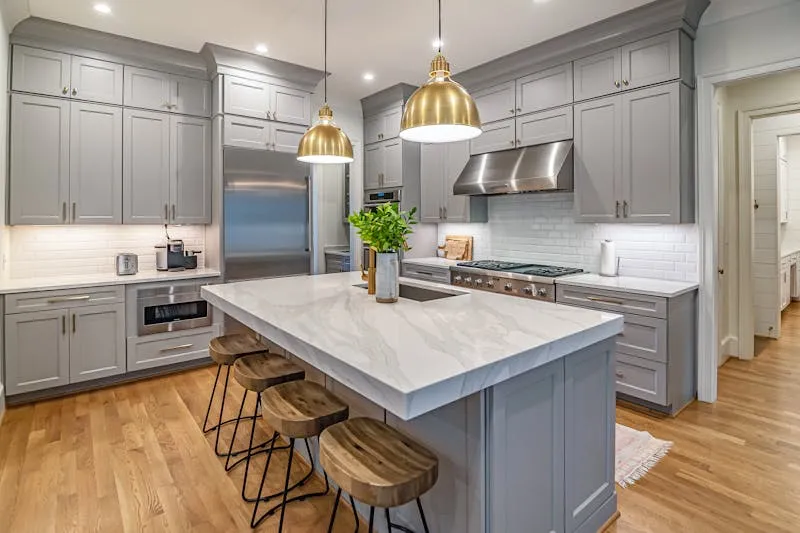
The kitchen is a workspace. You cut, you cook, you handle knives and boiling liquids. Lighting needs to be functional first — but that doesn't mean it should feel like an operating theatre.
Countertop lighting: LED strips or puck lights under upper cabinets (or spots recessed into the underside of cabinetry) are the most effective and attractive solution. Temperature: 3,000–4,000K. The critical point: light should fall directly onto the work surface, not be blocked by your body's shadow (which is exactly what happens when the only light source is a ceiling fixture behind you — you cast a shadow on precisely what you're trying to see).
Above the island or table: pendants are king. Three aligned pendants over an island is a design classic for a reason: it's beautiful and it works. Placement rule: the bottom of the pendant should hang roughly 28-32 inches above the countertop surface. Higher and it doesn't illuminate. Lower and it obstructs sightlines.
General ambiance: a ceiling fixture or recessed spots at 3,000K. This is the base layer that lights the floor, walls, and circulation zones. With a dimmer if possible — because the lighting that helps you cook dinner should be able to soften when you sit down to eat it.
The bedroom: soft, intimate, and ceiling-light-free
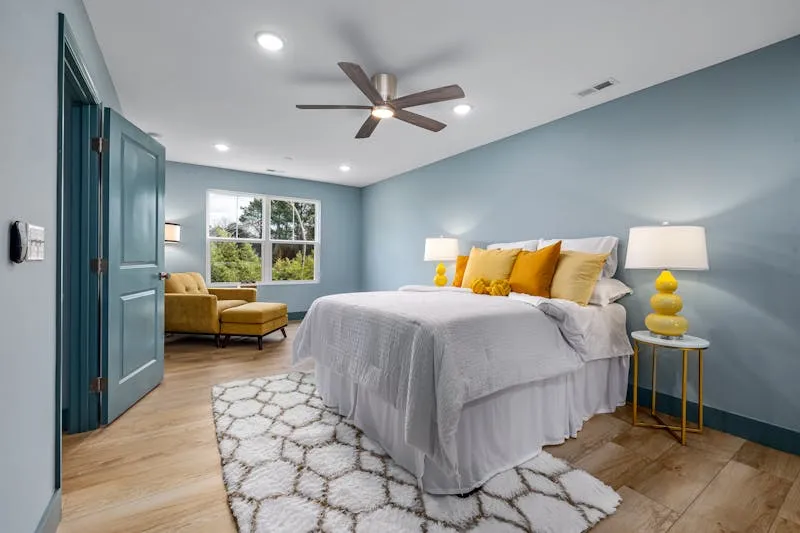
Here's a radical suggestion: if you can, eliminate the ceiling light in the bedroom. I'm serious. An overhead fixture in a bedroom is like a stadium floodlight in a spa. It corresponds to nothing you actually do in a bedroom — resting, reading, winding down, falling asleep. Light from above is stimulating; light from eye level or below is calming.
Bedside wall sconces are the number-one investment. Two sconces with articulated arms, one on each side of the bed, mounted at roughly 52-55 inches from the floor (the top of the fixture at head height when you're sitting up in bed). Each with its own switch — complete independence. You read, your partner sleeps. No ceiling fixture can offer that.
Table lamps on nightstands are the classic alternative. They work well, but they occupy surface area on often-small nightstands. Their advantage: easy installation (no wall wiring) and they double as decorative objects. Their downside: the light is typically less well-directed than an articulated sconce.
Accent lighting: a string light along the headboard, an LED strip behind a low dresser, or a simple LED candle on the chest of drawers. The bedroom is the only room where accent lighting can serve as the sole light source for extended periods — those winter evenings spent in bed with a book and a cup of tea.
Colour temperature: 2,700K, no exceptions. There is no situation in a bedroom that calls for anything higher. Melatonin — the sleep hormone — is suppressed by blue light (high Kelvin temperatures). Warm lighting in the evening promotes sleep onset. This is biology, not interior design preference.
The bathroom: the most underestimated lighting challenge
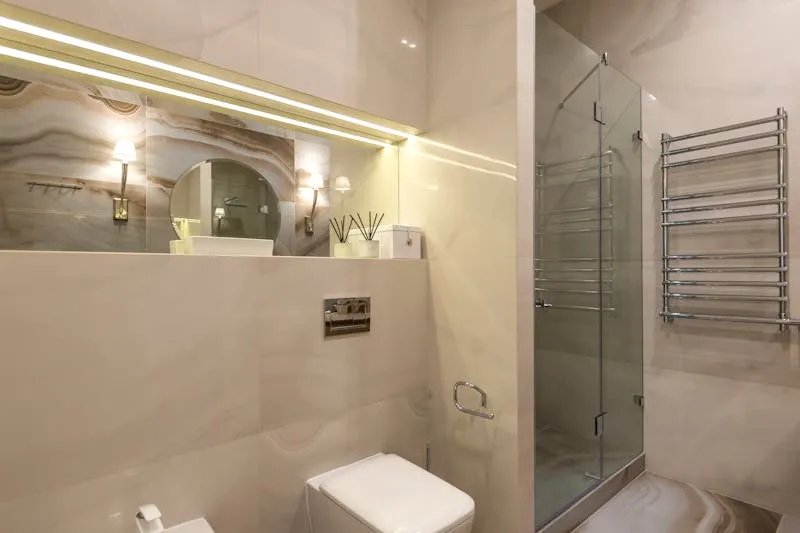
The bathroom is the room where lighting has the highest functional impact and the smallest margin for error. This is where you apply makeup, shave, examine your skin, check your appearance each morning. Bad bathroom lighting means a greenish complexion in the mirror, dark shadows under the eyes, and makeup that looks perfect at home but disastrous once you step outside.
Mirror lighting: this is THE critical point. The golden rule, ignored by 90% of installations: mirror lighting should NOT come exclusively from above. A single spot above the mirror creates harsh shadows under the eyes, nose, and chin — you look like a character in a horror film. The ideal mirror lighting comes from both sides (vertical sconces flanking the mirror) or wraps around the mirror on three sides (backlit mirror).
Colour temperature at the mirror: 4,000K. This is where neutral light is justified — it faithfully renders skin tones, clothing colours, and makeup shades. Makeup applied under 2,700K light will read too heavy once you step into daylight, because the warm light masks details and colour shifts.
General lighting: a ceiling fixture or recessed spots rated for wet areas (IP44 minimum in zones 1 and 2 around the bath/shower). Temperature: 3,000K for overall comfort. Dimmable ideally — because the light you need at 7 AM to get ready for work isn't the light you want at 9 PM for a relaxing bath.
For relaxing baths: a candle (waterproof LED or a real one in a secure holder), or a 2,700K LED strip installed under the vanity. Low, diffuse, warm light is the exact opposite of the standard bathroom ceiling fixture — and that contrast is what transforms a Tuesday night bath into a genuine decompression ritual.
The 6 most common lighting mistakes
After helping several friends rethink their home lighting (and having personally committed nearly every possible mistake), here are the most common traps — and more importantly, how to avoid them.
Mistake #1: Betting everything on the ceiling fixture. We've covered this, but it bears repeating: a ceiling light alone is office lighting. You need multiple sources (5-7 per main living space) to create depth and modulation. The overhead is the base, not the endpoint.
Mistake #2: Ignoring colour temperature. This is the most impactful factor and the least expensive to fix. Replacing every bulb above 3,000K with 2,700K warm whites in living spaces costs under $20 and radically changes the atmosphere. It's the first step before any fixture investment.
Mistake #3: Placing sources too high. The higher a light source, the more stimulating it is (think midday sun). The lower it is, the more calming (think sunset). Table lamps, floor lamps, and low-mounted sconces create warmer lighting than any ceiling fixture ever could. Bring the light down.
Mistake #4: Forgetting dimmers. A dimmer on every lighting circuit gives you total flexibility. Morning: 100%. Evening: 30%. Dinner party: 15%. Investment: $15-25 per dimmer, 20-minute installation for a handy person. The cost-to-impact ratio is the best in all of home decor.
Mistake #6: Choosing the fixture for its design before thinking about the lighting plan. A gorgeous chandelier hung in the wrong spot, with the wrong bulb, at the wrong height, won't produce beautiful light. Think plan first: where are the activities? What intensity and direction of light do I need? Only then choose the fixture that fills that function AND appeals to you visually. Design follows function — especially in lighting.
Frequently asked questions
How many lumens do you need per room?
The IES (Illuminating Engineering Society) recommends approximately 30 lumens per square foot for living rooms, 50 lumens per square foot for kitchens and offices, and 15-20 for bedrooms. In practice, for a 200 sq ft living room, that's roughly 6,000 total lumens across all sources. But that's an average: layered lighting lets you modulate — sometimes 1,000 lumens suffice (table lamps alone in the evening), sometimes you need 8,000 (deep-cleaning day). Hence the importance of dimmers.
LED, halogen, or incandescent: what should you choose in 2025?
LED, without question. Incandescent bulbs have been phased out of sale in most regions (the EU banned them in 2012, the US effectively followed in 2023). Halogens went next. Modern LEDs faithfully reproduce the warmth of old incandescents (2,700K) while consuming 80% less energy and lasting 15,000-25,000 hours (versus 1,000 for incandescent). The one spec to watch: choose LEDs with a CRI (colour rendering index) above 90 — this guarantees that colours in your space won't look washed out or distorted.
What's the right height for a pendant light above a dining table?
The standard rule: the bottom of the pendant should hang 28-34 inches above the table surface. More specifically: 28-30 inches for a dining table (to create an intimate cone of light without obstructing sightlines across the table), 32-34 inches for a kitchen island (where you're often standing). If the pendant is very large (over 16 inches in diameter), raise it slightly. If the ceiling is unusually high (over 9 feet), add 2-4 inches to compensate for the proportional difference.
How do you light a hallway or windowless entryway?
Hallways and entryways are transitional spaces — the lighting should be welcoming without being glaring. Wall sconces every 6-8 feet (directing light upward and/or downward) create an elegant gallery effect. Temperature: 2,700-3,000K. Avoid overpowered recessed spots (hospital corridor effect) and single central ceiling fixtures (one light source in a narrow space creates harsh shadows on the walls). A mirror at the end of the hallway amplifies both natural and artificial light and visually lengthens the space.
What budget should you plan for relighting a room?
It depends on your starting point. The bare minimum — replacing all bulbs with dimmable 2,700K LEDs and adding a dimmer switch — costs $30-60 per room. If you want to add table lamps and a floor lamp, budget $50-150 per fixture (retailers like IKEA, Target, and West Elm offer decent options starting at $30-40). A complete lighting overhaul for a living room (ceiling fixture + 2 table lamps + 1 floor lamp + LED strip) can be done for $150-400 depending on the range. That's often less than a single piece of furniture — for a far greater visual impact.