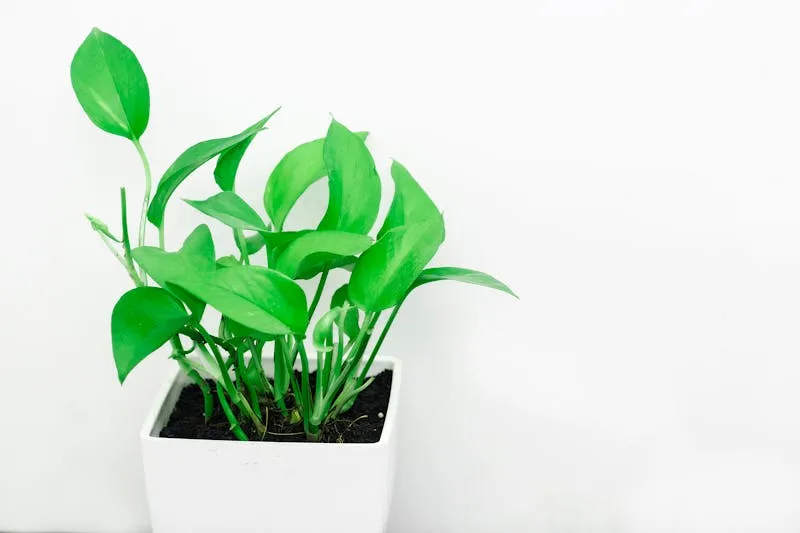
I killed a cactus. I know — supposedly impossible, and yet. A cute little round cactus from the garden centre one Saturday in March, placed on my desk with the best intentions in the world. Three weeks later: brown mush. Post-mortem diagnosis from my mum (who grows orchids in her bathroom, the witch): too much water. Obviously. I'd been watering my cactus like a tropical plant because "plants need water." Stellar reasoning.
If you recognise this scenario — the basil that dies on the balcony, the ficus that drops every leaf the moment you look at it sideways, the aloe vera turned into a soggy sock — welcome to the club. But I've got good news: some plants are biologically designed to withstand our neglect. Not plastic ones, mind. Real ones, with roots and photosynthesis, that tolerate forgotten watering, dark flats and three-week holidays with nobody to care for them.
After years of trial and error (mostly error) and an indecent number of empty pots in my London flat, I've finally identified the fifteen specimens that survive everything — including me. Here's the full guide: which plant for which corner of your home, how much light it actually needs, when to water it, and above all, the mistakes that kill them for good.
Why get houseplants (beyond looking nice)
Yes, a beautiful green plant looks great on Instagram. But there are slightly more solid reasons to bring them into your home.
The famous 1989 NASA study — the one everyone cites without having read — demonstrated that certain houseplants do filter volatile organic compounds (benzene, formaldehyde, trichloroethylene) from indoor air. Admittedly, the study used sealed chambers, not a draughty two-bed flat. But more recent work from the University of Exeter confirms that plants in a workspace increase productivity by 15% and reduce perceived stress. That's measured in real-world conditions.
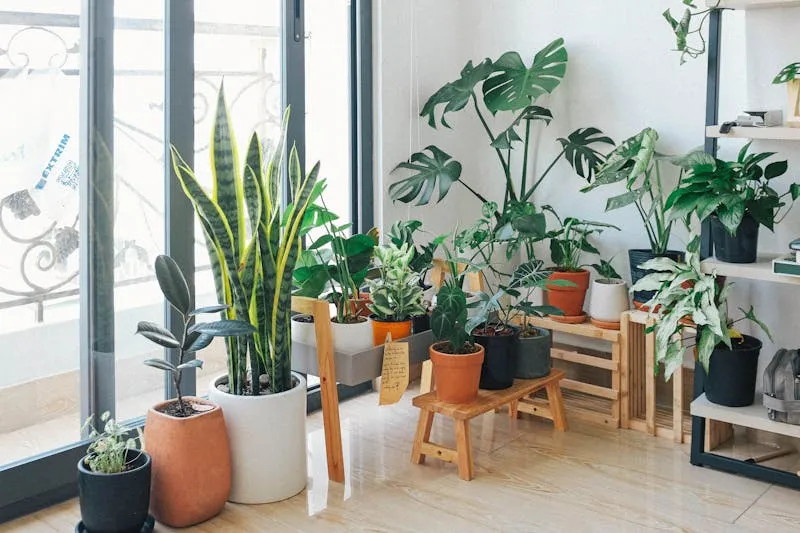
There's also the humidity regulation angle. In winter, with the heating on full blast, your flat's air can drop to 25–30% humidity — basically Saharan levels. Transpiring plants (peace lily, ferns, pothos) naturally raise this to the 40–50% range recommended by the NHS. Your skin, mucous membranes and sinuses will thank you.
Practical tip: Group your plants together. Combined evapotranspiration creates a humid microclimate that benefits all of them — it's the jungle effect. Three plants grouped together do better than three plants isolated in different corners of the room.
Finally, there's the purely decorative and biophilic aspect. Biophilia — our innate attraction to living things — explains why a space with plants immediately feels more welcoming, more "lived in" than a strictly mineral interior. It's not mysticism, it's evolution: our brains are wired to read vegetation as a signal of a favourable environment.
Top 5: the absolutely indestructible
These five survive everything. Forgotten watering for a month, north-facing flat, heating on full, extended absence — they genuinely don't care. If you kill one, you're really trying (or watering daily, which amounts to the same thing).
1. Pothos (Epipremnum aureum)
The plant for people who kill everything. The pothos is a tropical vine that grows literally anywhere: in water, in soil, hanging, on a shelf, in a windowless bathroom, in a dark hallway. I'm not even exaggerating. I've got one specimen that's survived for four years in my entrance hall — a room that receives about as much direct light as a cellar.
Light: tolerates everything from direct light (leaves pale) to the darkest corner (variegation fades but it survives). Watering: when the soil is dry 2–3cm down. In practice, once a week in summer, every 10–15 days in winter. Toxicity: toxic to cats and dogs — keep it on a high shelf if you've got pets.
2. Snake plant (Dracaena trifasciata)
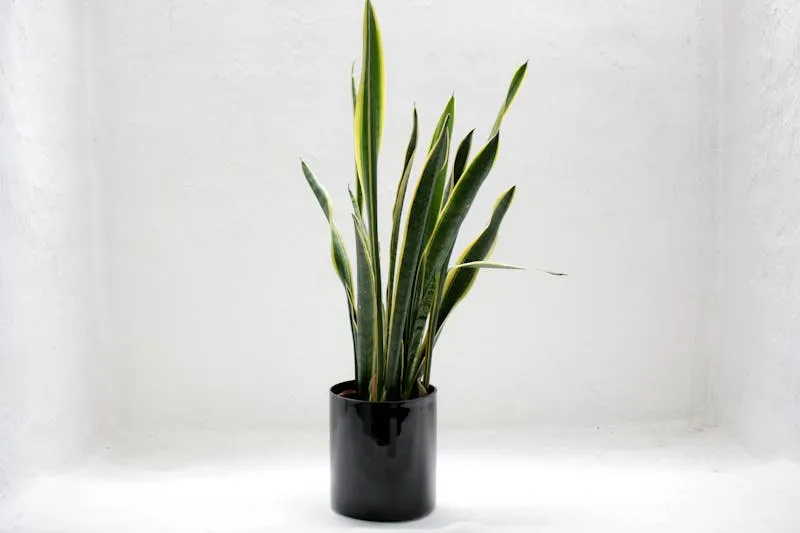
Also known as "mother-in-law's tongue" — because it's sharp and impossible to get rid of. The snake plant is the all-categories champion of indoor survival. It's nearly indestructible: it stores water in its thick leaves and can go weeks without watering. As a bonus, it filters air pollutants (benzene, formaldehyde, xylene) and produces oxygen at night, unlike most plants — perfect for a bedroom.
Light: from bright indirect to deep shade, it adapts. Watering: as little as possible. Every 15–20 days in summer, once a month in winter. The only way to kill it is overwatering. Repotting: it likes being root-bound — only repot when the roots are literally deforming the pot.
Warning: Never leave standing water in a snake plant's saucer. Its roots rot within days in permanent water. Empty the saucer 30 minutes after each watering.
3. ZZ plant (Zamioculcas zamiifolia)
If plants had an autopilot mode, this would be it. Originally from East Africa, the ZZ plant has underground rhizomes that store water like reservoirs — it can last two months without a single drop. Its thick, glossy leaves are naturally shiny (no leaf-shine spray needed, despite what some claim). It grows slowly, needs virtually zero maintenance, and looks spectacular in a tall narrow pot.
Light: indirect is ideal, but it tolerates shade beautifully. Avoid direct sun — leaves scorch. Watering: let the soil dry out completely between waterings. If in doubt, don't water. Note: all parts are toxic if ingested — keep away from toddlers and curious pets.
4. Aloe vera
The quintessential succulent, aloe vera is practically self-sufficient if you respect one rule: lots of light, very little water. Near a south or west-facing window, watered once every two to three weeks, it thrives without complaint. As a bonus, the gel from its leaves is a natural antiseptic for minor burns and sunburn — handy in summer.
The classic trap: putting it in a pretty pot without a drainage hole. Aloe vera DETESTS sitting in water. Terracotta pot with a hole, end of discussion.
5. Spider plant (Chlorophytum comosum)
Grandma's plant — and for good reason: it's been surviving for decades in homes that have never seen a gardening guide. The spider plant grows quickly, produces adorable "babies" dangling from long stems (lovely in a hanging pot), and tolerates virtually any conditions. It's also one of the top air-purifiers according to the NASA study.
Light: indirect to partial shade. Watering: regular but not excessive — soil should dry between waterings. Bonus: non-toxic to pets, making it ideal if your cat chews everything in sight.
Propagation tip: Spider plant "babies" root in water within 10 days. Free, infinite plants: you can give them to everyone you know without ever visiting a garden centre.
5 plants for dark flats
Your living room faces an internal courtyard? Your bedroom window opens onto a wall? Don't panic — these five plants are the queens of low light.
6. Cast iron plant (Aspidistra elatior)
Nicknamed the "cast iron plant" by the Victorians — who placed it in the lightless entrance halls of their London townhouses — the aspidistra is the tank of houseplants. It survives light conditions that most plants would consider a death sentence. Slow-growing, but virtually impossible to kill.
Watering: moderate. Let it dry well between waterings. Best feature: it also tolerates temperature swings and draughts — perfect for a hallway or corridor.
7. Peace lily (Spathiphyllum)
The only plant on this list that flowers in shade. Its white spathes appear even in low indirect light, which is remarkable for a flowering plant. The peace lily has a built-in alarm system: when it's thirsty, its leaves droop dramatically. Water it, and within two hours it perks right back up. Spectacular and incredibly useful for the forgetful.
Watering: when the leaves start drooping (or when the top 2cm of soil is dry). Humidity: loves humidity — ideal for a bathroom. Toxicity: irritant to pets, keep out of reach.
8. Chinese evergreen (Aglaonema)
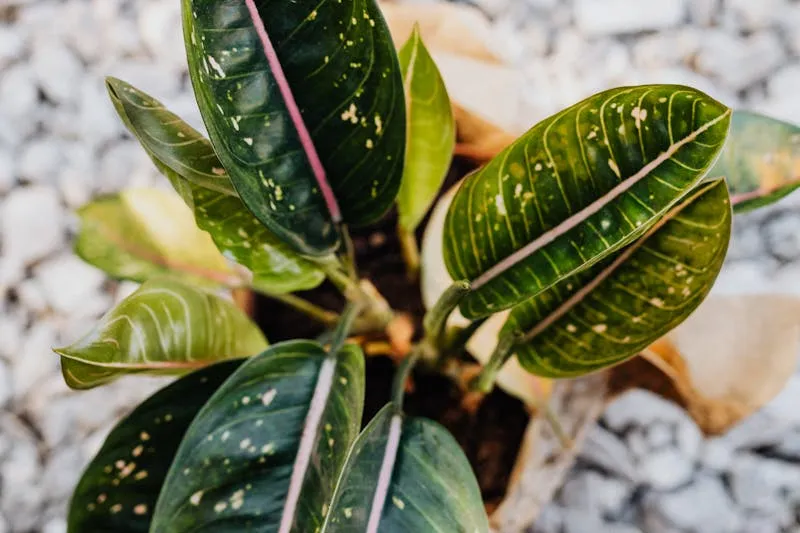
Underrated in Britain but an absolute star in Southeast Asia, the aglaonema comes in dozens of varieties with spectacular variegated foliage — from silver-green to vivid pink. It handles low light beautifully and needs moderate watering. Another advantage: it's compact, perfect for small spaces.
9. Heartleaf philodendron (Philodendron hederaceum)
Cousin to the pothos but with more pronounced heart-shaped leaves. A climbing or trailing vine depending on how you display it, the heartleaf philodendron tolerates partial shade and only needs watering when the soil dries out. It grows fast — one to two metres of vine per year in good conditions — and propagates in water just as easily as pothos.
10. Boston fern (Nephrolepis exaltata)
The fern is slightly more demanding than the others on this list — it wants humidity — but it's the queen of the bathroom. If you have a bathroom with even a small window, the Boston fern will be happier there than anywhere else. The humidity from your shower is enough, no mister needed.
Bathroom tip: Hang your fern from the ceiling with an adhesive hook. It catches shower steam, stays out of reach of pets, and transforms your bathroom into a mini tropical jungle. Guaranteed impact for about £12 all in.
5 statement plants that impress
These are a tiny bit less indestructible than the previous ones, but they're still very forgiving — and crucially, they look absolutely stunning. For going from "I've got three pots on the windowsill" to "hang on, do you live in a greenhouse? This is gorgeous."
11. Swiss cheese plant (Monstera deliciosa)
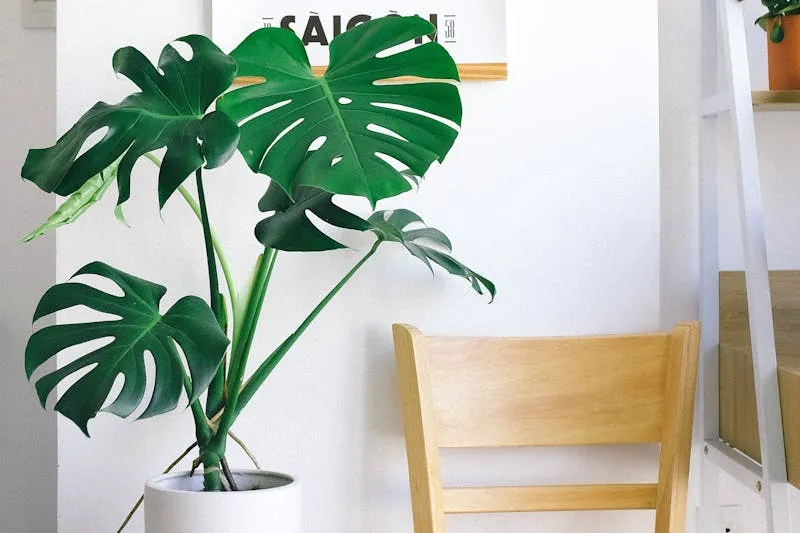
The absolute star of plant social media. And honestly, it deserves it: its large perforated leaves (the "fenestrations" in botanical jargon) are spectacular, especially once the plant reaches maturity. What many don't know: young monstera leaves are NOT perforated. The holes appear with age — sometimes you need two years of patience.
Light: bright to moderate indirect light. No direct sun — leaves scorch. Watering: when the top 3–4cm of soil is dry. Space: it can get VERY large — up to two metres indoors. Plan accordingly.
12. Fiddle-leaf fig (Ficus lyrata)
Large violin-shaped leaves, architectural form, magazine-worthy appearance — the fiddle-leaf fig is gorgeous. It's a bit fussier than the rest of this list (it hates being moved and despises draughts), but once you find the right spot — bright indirect light, no radiator nearby — it stays there for years without trouble.
Warning: The fiddle-leaf fig drops its leaves when stressed — and almost everything stresses it: moving house, draughts, irregular watering, changing its pot. Once it's settled, don't move it. Ever.
13. Chinese money plant (Pilea peperomioides)
A petite plant with perfectly circular leaves, like green coins on thin stems. Very Instagrammable, very compact (25–30cm max), and fairly easy if you give it indirect light and moderate watering. It produces loads of offsets at its base — "babies" you can detach and repot. The plant that multiplies itself.
14. Caladium
The caladium is the plant you buy thinking "this is going to die" — and against all odds, if you respect its needs (indirect light, moist soil, warmth), it lasts for months with its spectacular heart-shaped leaves in combinations of green, white, pink and red. Note: it's a bulb plant and goes dormant in winter (leaves die, that's normal, it comes back in spring).
15. Calathea (Goeppertia)
The calathea is the diva of this list. Its leaves with mind-boggling geometric patterns (stripes, spots, gradients) are genuinely natural works of art. BUT — it loves humidity, hates limescale in the water, and its leaf edges go brown if the air is too dry. Solution: bright bathroom or regular misting. If you're willing to give it a minimum of attention, the visual reward is immense.
The anti-drowning watering guide
Overwatering kills more houseplants than drought. It's counterintuitive, but it's a fact: 80% of dead houseplants died from too much water, not too little. Standing water at the bottom of the pot causes root rot (a fungus of the Pythium or Phytophthora genus), and once it sets in, it's virtually unrecoverable.
The finger rule: Push your index finger into the soil up to the second knuckle (~3cm). If it's still damp, don't water. If it's dry, water. It's the most reliable method, far better than any fixed schedule.
Watering summary table
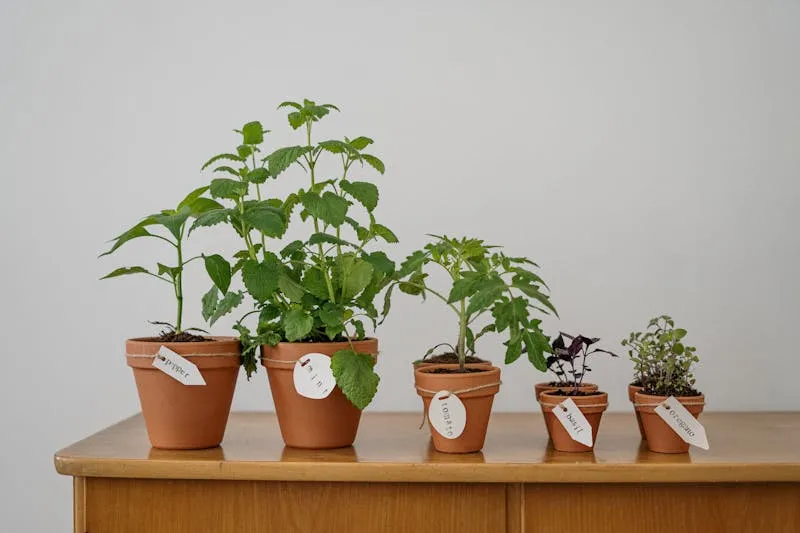
Succulents (aloe, snake plant, ZZ): every 15–30 days depending on season. Soil must dry out completely. Tropicals (pothos, monstera, philodendron): every 7–10 days in summer, 10–15 days in winter. Top 2–3cm of soil should dry. Humidity lovers (fern, calathea, peace lily): soil consistently lightly moist but never waterlogged. Regular misting if the air is dry.
Cold water warning: Never water with ice-cold water straight from the tap in winter. Tropical roots suffer thermal shock. Let the water sit for 30 minutes at room temperature, or use lukewarm water. Calatheas even prefer filtered or rainwater — limescale browns their leaves.
Light levels: understanding what your plant wants
Garden centre labels are often misleading. "Full sun," "partial shade," "bright indirect light" — what do these actually mean in a flat?
Direct light: the sun hits the plant directly through the glass. In practice, that's a south or south-west-facing window, within the first 50cm. Succulents and aloe love it; tropicals burn.
Bright indirect light: the room is very bright but the sun doesn't touch the plant directly. Typically 1–2 metres from a south window, or right in front of an east/west window. Ideal for 90% of the plants on this list.
Moderate indirect light: the room is lit but not bathed in sunlight. A north-facing window, or 3–4 metres from a south window. Pothos, snake plant, ZZ and aspidistra thrive here.
Low light: minimal natural light. Hallway, windowless bathroom, far corner of a room. Only pothos, snake plant and aspidistra truly survive here — and even then, growth will be very slow.
The shadow test: Hold your hand between the light source and the wall. If the shadow is sharp with well-defined edges, the light is bright. If the shadow is fuzzy and diffuse, the light is moderate. If you can barely see a shadow, it's low light. Simple, free, effective.
Repotting: when and how without wrecking everything
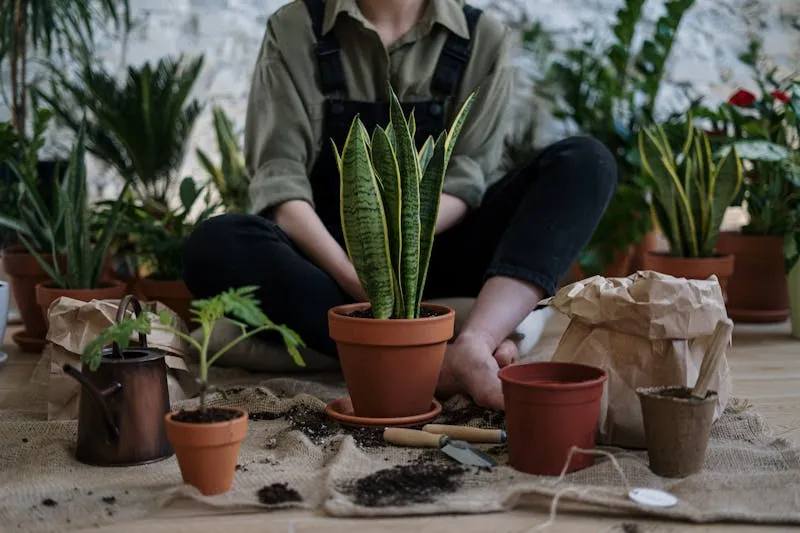
Rule number one of repotting: don't repot too often. Most houseplants prefer being slightly root-bound over drowning in an enormous pot. A pot that's too big means too much damp soil around the roots, which means rot.
When to repot
The signals are clear: roots poking out of drainage holes, the plant drinking its water in 24 hours (soil dries abnormally fast), growth stopping despite good conditions, or the pot visibly deformed by root pressure. Generally, every 1–2 years in spring (March to May) is enough for most species.
How to do it
Choose a pot with a drainage hole (non-negotiable) and maximum 2–3cm wider than the current one. Use appropriate compost: standard houseplant mix for tropicals, free-draining mix (compost + perlite + grit) for succulents. Gently turn out, tease apart roots that have wound round and round, place the root ball in the new pot, fill with fresh compost, firm lightly, water once. Done.
Warning: Never repot a stressed plant (yellow leaves, just arrived from a trip, just purchased). Let it acclimatise for 2–3 weeks first. And don't repot in the dead of winter: roots are dormant, they won't colonise the new soil, and the excess damp compost risks causing rot.
The 7 fatal mistakes (and how to avoid them)
After years of personal botanical massacres and testimonies from dozens of friends in the same boat, here's the top 7 mistakes that kill houseplants.
Mistake #1: The Sunday auto-water. Watering every Sunday without checking whether the soil is dry. In summer, it might not be enough. In winter, it's far too much. Always check with your finger.
Mistake #2: The drainage-free decorative pot. That gorgeous ceramic pot without a drainage hole turns any container into a swimming pool for roots. Solution: a plastic inner pot with holes inside the decorative pot, with a layer of clay pebbles at the bottom.
Mistake #3: Direct sun on a shade plant. "I'll put it in the sun, that'll do it good." No. A snake plant accustomed to shade shouldn't be suddenly exposed to July sun. Result: scorched leaves, irreversible white patches.
Mistake #4: The radiator as neighbour. Placing a plant directly above a radiator is a death sentence. Hot dry air rises directly onto the leaves, desiccates them and attracts spider mites. Minimum 50cm distance.
Mistake #5: The oversized repot. "This way it'll have room to grow." Except the excess soil stays damp, roots rot, and the plant drowns. One pot size up, 2–3cm wider, maximum.
Mistake #6: Leaf-shine spray. Those products that "make leaves gleam" block the stomata — the pores through which the plant breathes. To clean leaves, a damp cloth is all you need.
Mistake #7: Ignoring pests. Little flies around the soil? Fungus gnats, often a sign of overwatering. Tiny webs under the leaves? Spider mites, a sign of air too dry. Act early: a dose of diluted neem oil or insecticidal soap solves 90% of problems if you catch them at the start.
Plants and pets: the safe and the toxic
If you have a cat or dog, this section is critical. Many popular houseplants are toxic if ingested by pets — and cats in particular love chewing dangling leaves.
Non-toxic plants (safe for cats and dogs): spider plant, Boston fern, pilea, calathea. You can leave these within reach without worry.
Toxic plants (keep out of reach): pothos, monstera, philodendron, snake plant, aloe vera, peace lily, fiddle-leaf fig, caladium. Symptoms range from oral irritation to vomiting. If ingested, call your vet immediately.
Cat-proofing tip: Cats hate the smell of citrus. A few lemon peels in the pot deter most curious felines. Alternative solution: put some cat grass nearby — they'll chew the grass and leave your plants alone (in theory).
Where to buy plants without getting ripped off
A pothos for £2 at Lidl and a pothos for £15 from a nursery — is it the same plant, or isn't it?
Garden centres (Dobbies, Wyevale, local independents): good choice for beginners, plants generally healthy, staff often knowledgeable. Mid-range prices. Avoid reduced plants at the back of the aisle with yellow leaves.
Supermarkets (Lidl, Aldi, Ikea, M&S): unbeatable prices — a monstera for £4 at Lidl is genuinely possible. However, plants have often travelled in questionable conditions (cold, dark). Check roots, leaves, and be prepared for a longer settling-in period.
Local nurseries: the absolute best. Plants grown locally, often more robust, personalised advice. More expensive, but quality is rarely disappointing. Search Google Maps for "houseplant nursery" + your town.
Online (Patch Plants, Bloombox Club, Leaf Envy): convenient, delivered to your door, but you can't see the plant beforehand. Check reviews and the returns policy. In winter, tropical plants can suffer from cold during transit — order between April and September.
Swaps and cuttings: Facebook plant-swap groups, local events, Gumtree. Free or nearly free, and you often get plants already acclimatised to flat conditions. My favourite source for growing my collection without breaking the budget.
Houseplant FAQ
Why are my plant's leaves turning yellow?
Yellow leaves have several possible causes: overwatering (cause number one), insufficient light, nutrient deficiency (the plant needs feeding, especially after 6 months in the same compost), or simply the natural ageing of lower leaves. Check soil moisture first: if it's constantly damp, reduce watering immediately.
Do houseplants actually purify the air?
Yes, but not as much as marketing suggests. The 1989 NASA study showed that certain plants filter pollutants in sealed chambers, but in a normal flat with draughts, the effect is modest. You'd need roughly 10 plants per square metre for a significant impact. Plants are better at improving humidity and psychological wellbeing — which is already excellent.
How many plants can I have in my bedroom?
As many as you like. The myth that "plants steal oxygen at night" is scientifically false — the amount of CO2 a plant produces overnight is infinitely smaller than that of a human sleeping in the same room. Snake plants and aloe vera actually produce oxygen at night (CAM metabolism). Fill your bedroom with greenery if you fancy it.
How do I save a plant that looks dead?
Scratch the stem with your fingernail: if it's green underneath the bark, the plant is alive. Cut off everything dry or brown, reduce watering if the soil is waterlogged (or water if it's bone dry), place it somewhere bright but out of direct sun, and wait. Many plants come back from the brink — I've seen pothos regrow from a single green stem.
Do houseplants need fertiliser?
Yes, but sparingly. Fresh compost contains enough nutrients for 3–6 months. After that, a liquid houseplant feed once a month in spring and summer is plenty. In winter, no feeding — the plant is dormant. Over-fertilising is worse than not feeding at all: roots burn.
What's the easiest plant for a first purchase?
The pothos, without hesitation. It tolerates everything (shade, light, forgotten watering, overwatering), grows fast (quick gratification), propagates easily (free plants for your friends), and looks beautiful trailing or on a shelf. It's THE starter plant. Second choice: the snake plant, if you want something more architectural and even less thirsty.
Are artificial plants a good alternative?
If it's purely decorative, fair enough — some replicas are impressively realistic nowadays. But you lose all the benefits: no air filtering, no humidity regulation, no biophilia (the brain distinguishes real from fake plant, even subconsciously). With the plants on this list, there's genuinely no reason to resort to plastic — some are literally easier to keep alive than fake plants are to dust.