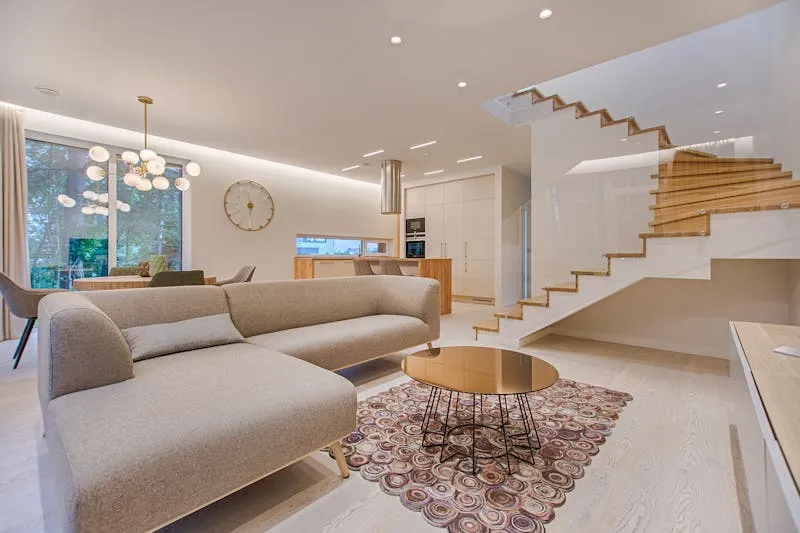
My friend Pauline had put her two-bedroom flat on the market in Bristol. Asking price: £285,000. Four months, twenty-two viewings, zero offers. Her estate agent was starting to mutter about "reducing by 10%." Translation: throwing £28,500 out the window. I offered her a deal: give me two weekends and a £1,000 budget. We cleared, cleaned, repainted, rearranged, styled. Result: sold in ten days. At £293,000.
That's home staging. Not magic, not deception — buyer psychology combined with presentation techniques anyone can apply. You're not renovating, you're not hiding flaws: you're showing your property at its absolute best so the buyer can picture themselves living there. And the figures prove it works — everywhere, at every price point, in every market.
The numbers that speak: ROI and time to sell
Home staging isn't a decorator's whim — it's a measurable investment. Here are figures compiled by the Home Staging Association UK and property portals:
- Average time to sell WITHOUT staging: 22 weeks in England and Wales (Rightmove, 2024)
- Average time to sell WITH staging: 3 to 6 weeks across studies
- Average reduction from asking price WITHOUT staging: -5 to -10%
- Average reduction WITH staging: -1 to -3% (when there is one)
- Average staging cost: 1-3% of sale price
- Average ROI: 5-15% — for every pound invested, £5-£15 in preserved value
Simply put: a property at £300,000 that would have sold for £270,000 after four months of haggling can sell at £295,000 within three weeks with £3,000-£5,000 of staging. The maths is clear.
Kristina's tip: Show these figures to your estate agent BEFORE any talk of reducing the price. Most agents know about staging but don't proactively suggest it. When you arrive with the data, they become your allies — and some even contribute to the cost because a quick sale benefits them too.
Buyer psychology
A buyer decides within the first 90 seconds of a viewing. Ninety seconds. That's how long it takes you to read this paragraph. In that time, the brain has already issued an emotional verdict — "I can see myself living here" or "no, on to the next one."
This verdict is not rational. It doesn't rest on the EPC rating, the exact square footage or the state of the plumbing. It rests on three things:
- Light: a bright space feels bigger, healthier, more welcoming. It's instinctive — our brains associate light with safety
- Space: a clear space allows projection. If the buyer sees YOUR furniture, they think about YOUR life. If the space is neutral and airy, they imagine THEIR life
- Smell: a bad smell (tobacco, pets, damp, cooking) is the number-one eliminator. Before the eyes even process, the nose has voted
Home staging works these three levers — and that's why it works even on "difficult" properties. You're not changing the property. You're changing the emotion the property triggers.
Watch out: Home staging does NOT mean hiding defects. Visible damp, structural cracks, a terrible EPC rating — these can't and mustn't be concealed. It's not only dishonest but also grounds for legal action under the Consumer Protection from Unfair Trading Regulations. Staging highlights qualities; it doesn't mask problems.
Step 1: Depersonalise without sterilising
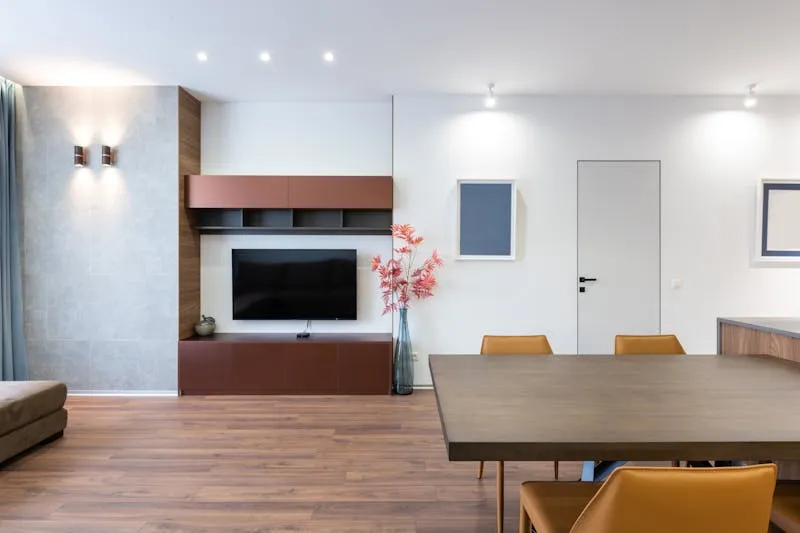
This is the foundational principle of staging, and often the hardest emotionally. You need the buyer to imagine THEIR future home — not to tour YOUR life.
What needs to go
- Family photos: all of them. Every photo is a reminder that "someone else lives here." Replace with neutral frames containing landscapes or abstract art
- Personal collections: your Star Wars figurines, your 200 DVDs, your bowling trophies. Into boxes, into the garage
- The fridge: remove all magnets, children's drawings, post-its. A fridge covered in daily life screams "this kitchen is too small to store things properly"
- Very personal colours: your purple feature wall, your fuchsia-pink bedroom. A coat of paint in off-white or pale grey costs £25-£40 per wall and instantly widens your buyer pool
- Religious or political items: whether subtle or not, they can unconsciously influence a buyer one way or another
What can stay (and should stay)
Be careful not to turn your home into a generic hotel room. The goal is "neutral but warm," not "cold and impersonal." What stays:
- A few well-chosen books (coffee-table books, cookery, travel)
- Green plants (they add life and freshness)
- Unlit candles (the idea of cosiness without the artificial scent)
- One or two "neutral but beautiful" decorative objects (a ceramic vase, a minimalist sculpture)
Kristina's tip: The "visiting stranger" rule. Imagine you're welcoming a friend-of-a-friend for the first time. You'd tidy away the overly personal stuff, leave what makes the place inviting, and put out a bunch of fresh flowers. That's exactly the right level of depersonalisation.
Step 2: Declutter — the hardest phase
Decluttering has the greatest impact — and is the most painful. Because we've lived among our furniture so long that we no longer see it eating the space. The golden rule: remove 30-50% of visible objects. Yes, that's a lot. Yes, it changes everything.
The room-by-room method
For each room, ask three questions:
- Does this object help the buyer understand the room's function? (yes = stays)
- Does this object make the room look bigger? (yes = stays)
- Is this object attractive and neutral? (yes = stays)
If the answer is no to all three: into boxes, into storage or to a friend's. Not the bin — you'll collect them after the sale. It's temporary.
The large pieces that must go
This is the most counter-intuitive but effective tip: remove at least one large piece of furniture per room. The living-room sideboard, the spare chest of drawers in the bedroom, the kitchen trolley. One fewer piece = 10-20 sq ft more visual space. And on property photos, those visual square feet make all the difference.
Watch out: Don't empty rooms completely. An empty flat is just as hard to sell as a cluttered one — buyers can't judge dimensions without reference furniture. A bed in the bedroom, a sofa and coffee table in the living room, a table and two chairs in the kitchen: that's the minimum for the buyer to "read" the space.
Step 3: Fix the "little things" that cost big
Buyers don't see big building work — they see small defects. A dead light switch, a broken door handle, a blackened bathroom sealant: these "details" send a devastating signal. The buyer's brain thinks: "If even the small things aren't maintained, what's hidden in the walls?"
The essential repair checklist
- Paint: touch up chips, marks, plug holes. A freshly painted off-white wall costs £25-£40 in paint and transforms the room
- Sealant: redo bathroom and kitchen seals. Cost: £5-£12. Time: 1 hour. Impact: enormous
- Handles and switches: replace anything broken, stained or dated. A set of modern handles costs £12-£25
- Bulbs: replace every dead bulb with warm-white LEDs (2,700K). Brightness is buyers' number-one criterion
- Taps: a dripping or sluggish tap costs £15-£60 to replace. Water that flows well = "the plumbing is sound"
- Cupboards: replace squeaky hinges, sagging shelves. A cupboard that opens effortlessly inspires confidence
Kristina's tip: Do a viewing of your own property as a buyer. Walk through the front door as if visiting for the first time. Note everything that snags your eye — a ceiling stain, a cracked tile, a visible cable. These are the things the buyer will see too. Fix them first.
Home staging room by room
The hallway — the first 10 seconds

The hallway sets the tone. If it's dark, cluttered and smells of shoes, the viewing starts badly. Action:
- Remove 80% of shoes and coats (keep 2-3 pairs max, one coat)
- A mirror to enlarge the space and bounce light
- A clean doormat (the tatty old mat spells "neglected" in capital letters)
- A plant or a bunch of fresh flowers
- Lighting: warm-white LED on for viewings, even during the day
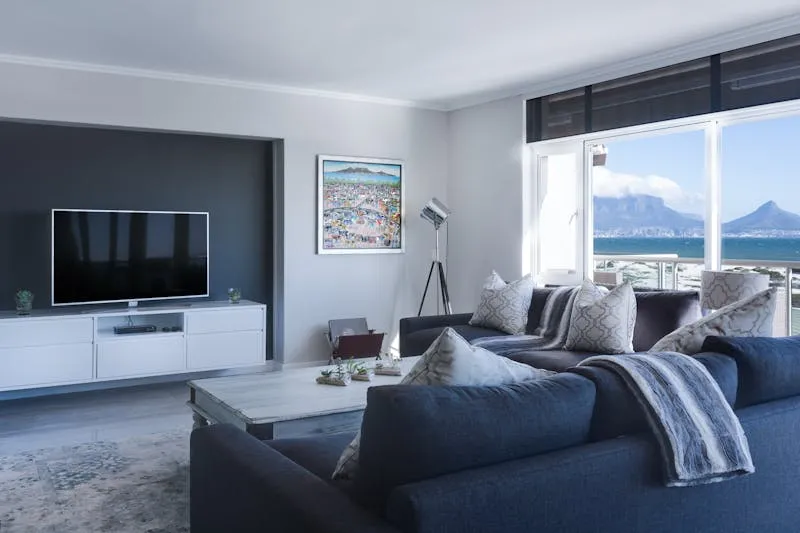
The living room — the projection space
The living room must say "life is good here." Action:
- One sofa only (remove the second if there are two), arranged to create a conversation zone
- A throw draped artfully, two or three neutral cushions — not twelve
- Remove the TV unit if possible (replace with a wall mount or leave the space free)
- Clear the coffee table: one beautiful book, a vase, a candle. No remotes
- Curtains open wide, windows cleaned (natural light sells)
The kitchen — absolute cleanliness
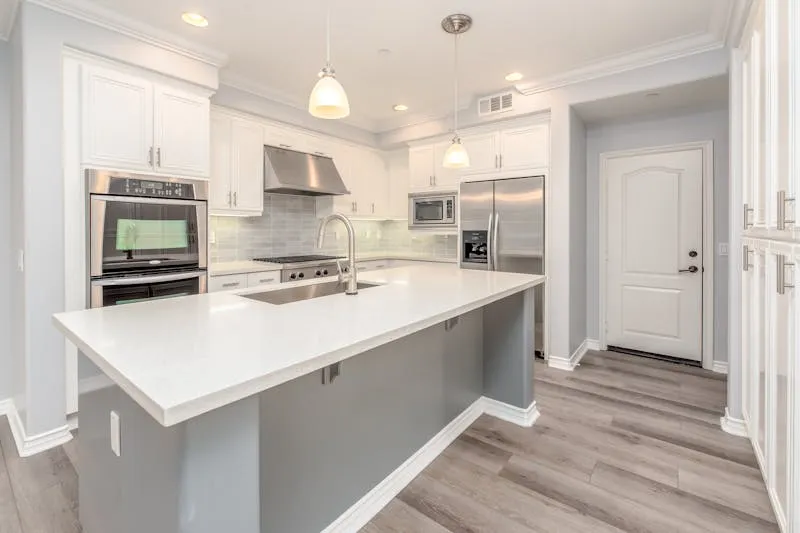
The kitchen is the room buyers scrutinise most (along with the bathroom). Cleanliness must be flawless.
- Worktops empty — nothing on them except perhaps a handsome fruit bowl
- Appliances stored in cupboards (coffee machine, toaster, Nutribullet)
- Inside cupboards neat and ordered (buyers open everything)
- No cooking smells — air out, wipe down with a neutral cleaner
- Fresh or new tea towels (£2 for a pack from Primark)
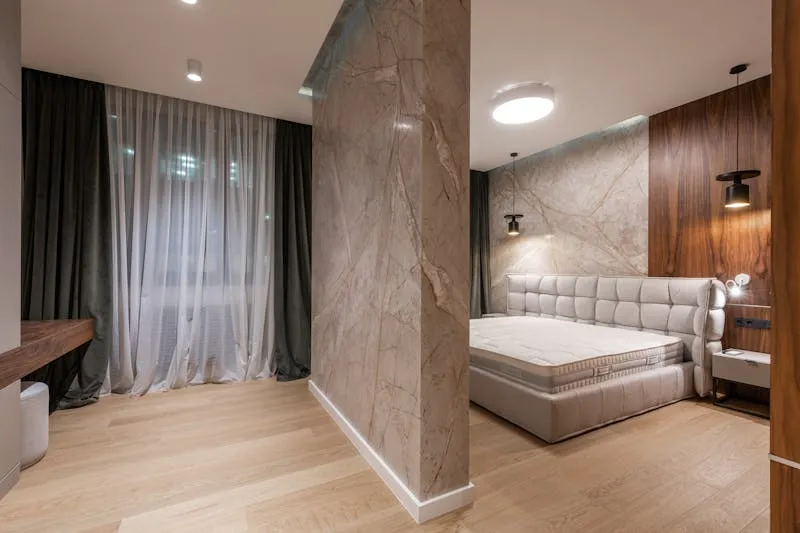
The bedroom — the retreat
- White or ecru bed linen, ironed — the hotel standard works every time
- Two symmetrical bedside tables (even if you live alone — symmetry sells)
- Remove clothes, chargers, screens
- One or two decorative cushions, a throw folded at the foot of the bed
- Curtains that let in maximum light
The bathroom — the spa
- Sealant redone (non-negotiable — black mould sealant sends people running)
- New white towels rolled hotel-style (£5-£8 for a set)
- A design soap or hand wash (not the half-empty supermarket bottle)
- A green plant (pothos loves bathrooms)
- Remove ALL personal products from the bath edge and basin
The exterior — curb appeal
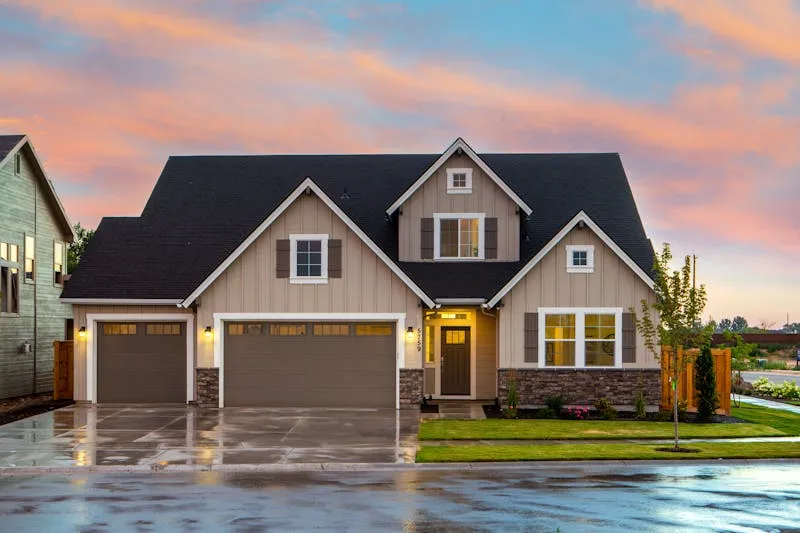
If you're selling a house, the exterior is the first thing a buyer sees — in person AND in listing photos.
- Lawn mowed, hedges trimmed, path weeded
- Front door clean — a fresh coat of paint if it's looking tired (£25)
- Pots of flowers at the entrance (two is enough, with seasonal plants)
- Letterbox in good condition, house number clearly visible
- Working exterior lighting for evening viewings
Property photos that sell
In 2025, 95% of buyers begin their search online. Your listing photos are the first (and often only) chance to trigger a viewing. A property with quality photos gets 3-5 times more clicks than one with poor images — even at the same size and price.
The basic rules
- Natural light: photograph during the day, all lights switched on as well (yes, both at once)
- Wide angle: a wide-angle lens or smartphone on 0.5x shows the volumes. But not too wide — it distorts and buyers feel deceived
- Height: camera at chest height (110-120 cm), not eye level. It shows more floor and enlarges
- Number: 15-25 photos is enough. Fewer, buyers are suspicious. More, they get lost
- Order: exterior → hallway → living room → kitchen → bedroom(s) → bathroom(s) → garden. The logical tour sequence
Kristina's tip: If you can only invest in one thing for the sale, invest in a professional property photographer. Cost: £120-£250 for a full shoot. The ROI is instant — listings with pro photos receive 118% more views (source: Rightmove). It's the single best staging investment.
Realistic budget and expected ROI
A staging budget runs between 0.5% and 3% of the sale price. It's an investment, not an expense — the distinction is fundamental. Here are realistic brackets:
"Essential" budget — £150-£400
- Off-white paint (2-3 walls): £40-£80
- Bathroom + kitchen sealant: £8-£15
- New white bed linen: £25-£50
- New white towels: £8-£12
- Warm-white LED bulbs: £10-£20
- New handles: £12-£25
- Green plants + pots: £20-£40
- Cleaning products + deep clean: £15-£30
- Professional photographer: £120-£200
"Complete" budget — £800-£2,500
Includes the essential budget plus:
- Cushions, throws, neutral curtains: £80-£200
- Small accent furniture (console, coffee table): £80-£250
- Decor objects (frames, vases, candles): £40-£120
- Storage unit 1-2 months for removed furniture: £60-£150/month
- Professional deep clean: £120-£250
"Professional" budget — £2,500-£6,000
When you hire a professional stager who provides rental furniture:
- Full service (consultation + styling + furniture + photography): £2,000-£4,000
- Furniture hire: £400-£1,500 for 2-3 months
- Full staging for an empty property: £2,500-£6,000
Watch out: Don't invest more than 3% of the sale price in staging. Beyond that, ROI drops sharply. A property at £200,000 doesn't justify £10,000 of staging — £800-£1,500 will do 90% of the work. The law of diminishing returns applies fully here.
DIY or hire a pro?
Every seller asks this, and the answer depends on three factors: your budget, your available time, and your ability to step back from your own home (the hardest of the three).
DIY works if:
- You have an eye for design (and an honest friend who'll confirm it)
- You have the time (allow 2-4 weekends for a full staging)
- You can emotionally "detach" from your home — see it as a product, not your sanctuary
- Your staging budget is under £800
A pro is worth it if:
- The property has been on the market for over 3 months with no offer
- The property is empty (staged furniture changes everything)
- The property is above £350,000 (pro staging ROI scales with price)
- You have neither the time nor the inclination
- You can't step back objectively (that's 90% of sellers — no shame)
Where to find a stager
The structured networks: Home Staging Association UK, BIID members who offer staging, or independents found through Houzz, Google or your estate agent's recommendation. Always verify real before-and-afters (not stock images) and ask for client references.
Kristina's tip: Even if you're staging yourself, invest in a one-hour consultation with a pro (£60-£120). They visit, give you a prioritised action list, and you execute. It's the perfect compromise between DIY budget and expert eye.
Frequently asked questions about home staging
Is home staging deceptive?
No. Staging conceals nothing — it enhances. It's the difference between posing for a photo in good lighting and digitally de-ageing yourself by twenty years. All structural issues, surveys and legal disclosures remain transparent. Staging works on the buyer's emotion, not on the facts.
Does it work for rentals too?
Yes, and increasingly so. A staged rental property lets faster and often at a higher rent (5-10% premium according to studies). It's particularly effective for short-term lets (Airbnb) where photos are decisive.
Should you stage a new-build?
An empty new-build is paradoxically one of the hardest properties to sell — buyers can't judge volumes or project without reference furniture. Staged furniture (even minimal) solves this and accelerates sales. Developers know this: their "show homes" are nothing but professional staging.
How long does staging take?
A full DIY staging takes 2-4 weekends. A professional staging is done in 1-2 days of intervention. Rental furniture stays in place during marketing (2-3 months on average). You're not redecorating — you're temporarily setting the scene.
Can the estate agent fund the staging?
Some agents include staging in their fees or partner with a stager. It's uncommon but it exists — ask. The argument that works: a staged property sells faster, so the agent earns their commission sooner. Everyone wins.
What are the most common staging mistakes?
Top of the list: over-decluttering (an empty property sells no better than a cluttered one), neglecting smells (synthetic air freshener smells like "hiding something"), and forgetting exteriors (balcony, terrace, garden). The other frequent error: staging the living room but forgetting the bathroom — buyers inspect EVERYTHING.