The changing room breakdown
We've all been there. The aggressive fluorescent light of a fitting room, a mirror that forgives nothing, and a pile of eight pairs of jeans that — one after the other — just don't work. Too long. Too tight on the thighs. Gaping at the waist. The button closes but you can't breathe. You leave the shop empty-handed and your self-esteem somewhere near your ankles.
The problem isn't your body. It's that you haven't found YOUR cut yet.
And honestly? Nobody teaches us this properly. We get told "the skinny elongates", "the flare balances", "the boyfriend is comfortable" — without anyone explaining why, or how to test it on your actual body. This guide fixes that. No "hide your flaws" because your body doesn't have flaws. Just garment mechanics: how cuts work, how fabric moves, and how to find what works for YOU rather than what's supposed to work in theory.
The cuts explained: your complete lexicon
Before we talk about body types, let's understand what each cut actually does. The vocabulary of denim gets thrown around loosely — "slim" and "skinny" are not synonyms, and "boyfriend" and "mom" don't describe the same trouser.
Skinny — not dead, just evolved
The skinny adheres to the leg from the knee to the ankle. It's a sculpting cut that reveals the silhouette in full. Fashion magazines have been writing its obituaries for years. It hasn't died. It's simply stepped back from being the dominant cut, which is fine — dominance rarely improves anything.
What skinny does well: it visually lengthens the legs, it tucks under boots beautifully, and it creates intentional volume contrast when paired with oversized tops. What it doesn't do: give room to powerful thighs and calves, or be genuinely comfortable on a three-hour train journey to Edinburgh.
Slim/Straight — the new sensible default
The slim straight has become the most versatile cut on the market. It's fitted without being clingy, and it falls straight from the thigh to the ankle. The difference between "slim" and "straight": slim is slightly more fitted at the thigh, straight falls more vertically from the hip.
This is probably the cut that works for the broadest range of body types — not because it "flatters" everyone (no cut does), but because it's neutral. It doesn't fight your body, it follows it.
Mum/Boyfriend — the difference nobody explains
These two cuts are often confused because they share a characteristic: they're relaxed. But they come from different places.
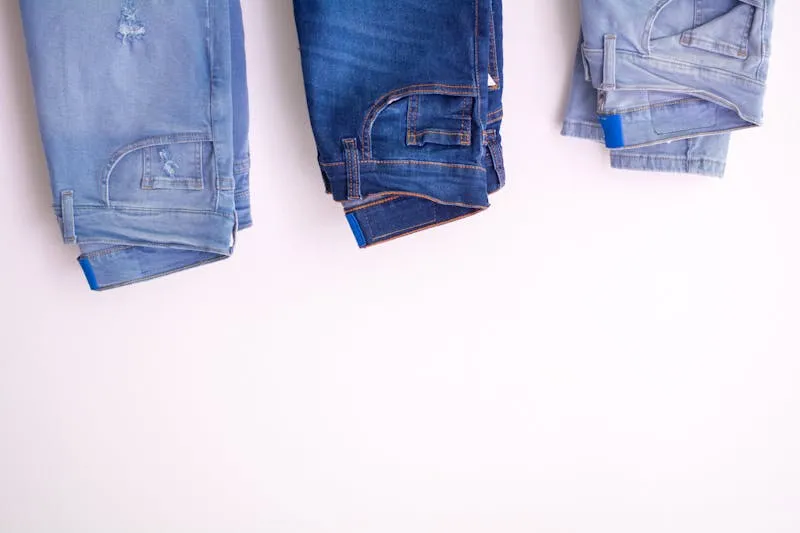
The mum jean is high-waisted (sometimes very high) with a leg that slightly tapers towards the hem. It was the standard jean of the 80s and 90s before the skinny took over. The high waist creates a clean visual break that defines the silhouette.
The boyfriend jean is more horizontal in its cut — it "borrows" from a boyfriend's wardrobe, so it's wider at the thigh and more relaxed in its fall. It often sits lower on the hips. The risk: the "falling down" effect if the waist is too low or the fabric too soft.
Wide-leg — proportions matter, full stop
The wide-leg has been the hero of collections since 2022, and it's earned its moment: it's comfortable, it's a statement, and it taps into a 70s-minimalist aesthetic that keeps reappearing. But it's also the cut that demands the most attention to proportions.
The fundamental rule of wide-leg: hem length is critical. A wide-leg that's too short makes legs look short and the silhouette squat. A wide-leg that grazes the floor elongates and elevates. Between the two, there isn't really a satisfying middle ground — you have to pick a side.
Second rule: volume at the bottom requires structure at the top. A wide-leg with a floaty t-shirt creates a "theatre costume" effect. With a fitted bodysuit, a tucked-in top, or a structured blazer, the proportions come back into balance.

Bootcut — the comeback it deserved
The bootcut was mocked for a decade. It represented the pre-skinny era, the early 2000s, those makeover shows with the inexplicable makeovers. Then — as fashion always does — it came back. Not identical, but rehabilitated.
The contemporary version is more subtle than the pronounced flare of 2003. The flare begins at the knee or just below, and it's moderate. What it does: rebalances a silhouette by creating volume at the lower leg, which can visually lighten the upper half. It's also the cut that works best with boots (logically) — it lets them be seen without crushing them.
Flare — the statement of statements
The flare is the bootcut with declared intent. The flare is pronounced, it starts high on the thigh, and it creates a volume of leg that is clearly a style choice. It's the 70s cut, the disco cut, the "yes, I am here" cut.
It works particularly well with heels (which lengthen and accentuate the movement) and short or tucked-in tops. This is a cut with personality — it doesn't wear like an ordinary pair of jeans, it wears like a piece of fashion.

Waist height: low, mid, high — which one for you?
Waist height probably has more impact on how a jean feels and looks than the cut itself.
Low-rise — risky, but not gone
Low-rise (sitting below the navel, sometimes very low on the hips) has been back in streetwear collections and on fast-fashion sites. It's being worn by Gen Z who didn't live through the first wave of the noughties and therefore don't carry the trauma of visible thongs and deeply embarrassing photos.
It's difficult to wear without a top that manages the transition. It cuts the silhouette at the widest part of the hips and abdomen. That's not a question of body type — it's a question of styling intention. If you want to try low-rise, start with a "micro-low" (just below the navel, not at the pubic bone).
Mid-rise — the comfort/style compromise
Mid-rise sits at or just above the navel. It's the most versatile height: it doesn't cut at the widest point of the hip, it's comfortable sitting down, and it works with a huge variety of tops — from a cropped tee to a blazer to an oversized knit.
High-rise — the elongating cut
High-rise sits clearly above the navel — sometimes at the natural waist. This positioning has a precise visual effect: it cuts the silhouette at its narrowest point (the waist), creating the impression of longer legs and a more defined hip.
For short torsos (limited space between the ribs and hips), very high rise can feel compressing visually. For long torsos, it's an extraordinary ally.
Fabric, weight, stretch: what the label doesn't tell you
We look at the cut, the colour, the price — and rarely the fabric composition. That's a mistake. The fabric determines the comfort, the durability, and the long-term appearance.
100% cotton — pure denim
Pure cotton is original denim. It's stiff when you first buy it (it needs "breaking in"), it stretches slightly at the knees and seat over time, and it develops a unique patina. Selvedge denim devotees swear by nothing else.
Advantages: it holds its shape for years and ages beautifully. Disadvantage: it's less comfortable day-to-day (less flexibility) and it doesn't forgive fluctuations in size.
Stretch denim — the comfort revolution
Adding elastane (or Lycra — same thing) to denim changed the market. A percentage of 1-2% is enough to make a jean significantly more flexible and comfortable. Above 5%, you're in "super stretch" territory — the fabric is closer to a legging than traditional denim.
The risk with excessive stretch: "baggy knees". After a few hours of wear, the knees form bubbles because the fabric has stretched out. The higher the elastane percentage, the more pronounced this becomes.

Denim weight — the oz question
Denim enthusiasts talk in "oz" (ounces) to describe fabric weight. Lightweight denim is 8-10 oz (summer, fluid), standard denim is 11-12 oz (versatile), heavy denim is 13 oz and above (structured, rigid, vintage look).
Fast fashion jeans often use 8-9 oz denim to reduce costs — which is why they can feel thin and insubstantial. Premium brands work with 12-14 oz for their signature cuts.
Selvedge — the snobbery that's occasionally justified
Selvedge denim is woven on traditional shuttle looms that produce a clean finished edge. You can spot it by the coloured border visible when you turn up the cuff. It's more expensive, stiffer, and its fans will spend 20 minutes explaining exactly why it's superior to everything else. They're not entirely wrong about the durability — but it's an investment, not a necessity.
The fit test: squat, sit, breathe
There's a reason fitting rooms exist: jeans need to be tested in movement, not just standing face-on in a mirror. Here's the protocol I use every single time.
The squat test
Bend your knees until you're crouching (or semi-crouching). If the jean pulls painfully at the seat and thighs, or the fabric looks like it might give, it's too small. If there's a massive excess of fabric at the crotch, it's too big or badly cut for your proportions.
The sit test
Sit on the fitting room bench (or the floor if you have no qualms — and you shouldn't). Does the waist gap at the back? Does the jean compress your stomach to the point of discomfort? Could you realistically wear this for eight hours at work?
The breathing test
Button up. Take a deep breath. If you have to hold your breath to keep the button closed, that's a size too small. A jean that compresses your stomach in a seated position is a jean that will live in your wardrobe unworn.
The back gap — and how to fix it
The infamous back gap (a gaping space between the waistband and your lower back) is one of the most common jean problems. It comes from the difference between hip and waist measurements — if your waist is significantly narrower than your hips, standard-cut jeans will create this gap.
Solutions: look for brands offering "curvy fit" cuts (Levi's, ASOS Curve, M&S Per Una have decent options) which have a more generous hip-to-waist ratio. Or have the waist taken in by a tailor — it's usually £15-25 and transforms a "nearly perfect" jean into an actually perfect one.
Sizing reality: why you're a 10 here and a 14 there
Nothing destabilises your sense of self quite like being a size 10 in one shop and a size 14 in another. And yet this is the reality of the market — and it has nothing to do with your body.
Vanity sizing
Vanity sizing describes the phenomenon where brands progressively reduce their nominal sizes to flatter customers. A "size 10" today often corresponds to what was a "size 12" twenty years ago. It's marketing, it's debatable, but it's everywhere.
The UK sizing conversion nightmare
Denim has the advantage (or disadvantage) of often using inch measurements: W (waist) and L (length, inseam). A "W28 L32" jean is 28 inches at the waist and 32 inches inseam (approximately 71cm waist, 81cm inseam).
Approximate conversions for reference:
- W24-25 = UK 6-8
- W26-27 = UK 8-10
- W28-29 = UK 10-12
- W30-31 = UK 12-14
- W32-33 = UK 14-16
- W34+ = UK 16+
These correspondences vary by brand. The only reliable approach: measure yourself (waist and hips) and compare against the brand's size guide.
By body type (body-positive edition)
I want to be clear about what this section is and isn't. It's not "here's how to hide your flaws". It's garment mechanics: how cuts interact with different proportions. There's no "difficult" body type — just cuts that work better with certain ratios.

Wider hips relative to shoulders
Cuts that work mechanically: straight high-rise (defines the waist, follows the hips without exaggerating them), wide-leg (creates volume below that rebalances the upper body), bootcut (slight flare at the hem compensates for hip width). What can create visual tension: a very clingy skinny that emphasises every curve without defining any of them.
Athletic / straight silhouette
Good news: almost all cuts work. The absence of a pronounced waist-to-hip differential means you can experiment freely. If you want to create curves: high-rise + short top + bootcut or flare. If you want to affirm the line: slim straight or straight in full length.
Petite (under 5'3")
Length is the absolute priority. A too-long jean on a petite frame shortens and overwhelms. Look for "cropped" or "ankle" styles that stop at the ankle without excessive break. Several brands offer specific petite ranges (ASOS Petite, Topshop's legacy petite range, M&S Petite) — these are actual cuts, not just shortened lengths.
Worth avoiding: very volumey wide-leg styles and jeans with large patch pockets at the thigh (the eye is drawn downward, which can create a "squat" effect).
Tall (5'9" and above)
The recurring problem: finding the right inseam. An L32 is often too short. Look for brands offering L34 or L36 options (ASOS Tall, Long Tall Sally, Uniqlo, Gap Long). Wide-leg and flare cuts are particularly impressive on tall frames — the length of leg amplifies the movement of the cut.
Brands by budget: high street to investment
The best jeans aren't always the most expensive. But cheap isn't always economical either — a £20 pair replaced every year costs more than a £120 pair that lasts a decade.
Budget (£20-50) — not necessarily bad
H&M: cuts vary significantly across their ranges. Their standard denim basics in half-stretch cotton are often genuinely decent. Fit tends to be true to size.
ASOS own brand: the range is enormous, sizing is inclusive, and they're constantly updating cuts to follow trends. Quality varies — check reviews before buying. Their petite and tall ranges are legitimately different cuts.
M&S: consistently underrated. Their "Magic" shaping denim gets obsessive reviews. Mid-price point with reliability most high street brands don't manage. The Sienna and Lily cuts are consistent bestsellers for good reason.
Mid-range (£60-150) — the real versatility
Levi's: the absolute reference. The 501 (straight, non-stretch, legendary), the 721 (high-rise skinny), the 724 (high-rise straight), the 725 (bootcut). The cuts are well-documented, sizing is consistent, durability is proven. Levi's sales on their UK site regularly bring good jeans down to £60-70.
Weekday: the Swedish brand has become a serious denim destination. Their Space and Voyage cuts are cult favourites. Excellent quality-to-price ratio, genuinely contemporary cuts.
COS: minimalist, excellent for architectural cuts (wide-leg, strict straight). Good fabric quality. Minimal stretch — better for those who prefer pure denim.
Topshop (ASOS archive): Topshop's jean legacy lives on through ASOS. The Joni high-waist skinny and the Jamie still have devoted followings. The brand's denim expertise was real — and those archive cuts are worth looking for.
Investment (£150+) — when jeans become a wardrobe piece
Citizens of Humanity: the American premium brand that popularised luxury wide-leg. Their jeans are built to last a decade. The Horseshoe (wide) and Isola (straight) are excellent premium staples.
AGOLDE: creators of one of the most imitated silhouettes of recent years (the 90's Pinch Waist). Primarily high-rise, mostly no-stretch denim. Expensive but very well constructed.
Totême: the Scandinavian brand that's become a reference for luxury minimalism. Their jeans are discreet, perfectly cut, and wearable for decades.
Denim care: how to keep your jeans for 10 years
Denim care is one of the most debated topics in fashion communities. There's a genuine opposition between the "no-wash" devotees (never wash your jeans) and the "wash regularly" camp.
How long between washes?
Levi's officially recommends washing jeans every 10 wears. That's a reasonable benchmark. 100% cotton denim handles long intervals without washing well — it breaks in and develops a unique patina. Stretch denim deteriorates faster under heat and repeated washing.
How to wash to preserve
- Turn jeans inside out before washing (protects the colour)
- Cold water or 30°C maximum
- Delicate or synthetics cycle
- No fabric softener (degrades elastane fibres)
- Air dry, never tumble dry (it shrinks and deteriorates stretch)
Colour loss — normal or not?
Indigo denim loses colour with washing — that's normal and part of the denim's aging. What's not normal: massive fading after the first wash, irregular bleaching, or colour that transfers onto everything for weeks after the first wash. These signs indicate poor quality dye.
Frequently asked questions
What is the most universally flattering jean cut?
The slim straight or straight cut (like the Levi's 724 or Weekday's Space) is the cut that works for the broadest range of body types and styles. It's neither too fitted nor too loose, it falls well in length, and it works with varied tops. If you want one versatile cut in your wardrobe, start there.
How do I choose between mum jeans and wide-leg?
Mum jeans are more fitted on the thigh and more practical for daily life — better at work, on public transport, in a meeting. The wide-leg is a stronger style statement that requires more thought about top proportions and a precise hem length. If you want an elevated casual jean, go mum. If you want a deliberate fashion piece, go wide-leg.
Are skinny jeans actually out?
No. They're less dominant than they were between 2010 and 2018, but they haven't disappeared, and they'll come back in force eventually (fashion is cyclical). If you love the skinny and it works for you, wear it. The "it's dated therefore forbidden" rule is a magazine invention, not a law.
How do I fix the gap at the waist of jeans?
The back waist gap appears when the difference between your hip and waist measurement is larger than the standard jean's cut accounts for. Solutions: look for "curvy fit" styles (Levi's, M&S, ASOS Curve all offer these) which have a more generous hip-to-waist ratio, try sizing up in waist and having it taken in if needed, or have a tailor add elastic at the inner waistband — a simple, cheap fix that works beautifully.
Is it worth spending a lot on jeans?
For basics (a straight indigo jean, a classic straight-leg in dark denim), investing in quality makes sense — you'll wear these pieces for years. For fashion-forward cuts (the flare you're trying this season, the light-wash wide-leg for summer), mid-range is usually sufficient. The rule: if you can picture wearing this jean in five years, invest. If it's a fashion experiment, save your budget.
How do I care for stretch jeans to maintain their shape?
Wash on cold, delicate cycle, air dry only (never tumble dry). Elastane doesn't respond well to heat — it degrades the stretch and can cause permanent deformation. Space out washes (aim for 10 wears minimum between machine washes) and air the jean between uses rather than washing it automatically.
What length should a wide-leg jean be?
Wide-leg works at two lengths: grazing the floor (with or without heels) for a maxi-silhouette effect, or stopping at the ankle with the shoes visible (the ankle crop). Anything in between — mid-calf, below the knee — usually looks awkward. If your jeans are too long, get them hemmed. If you want a cropped look, look for a style specifically designed at that length.