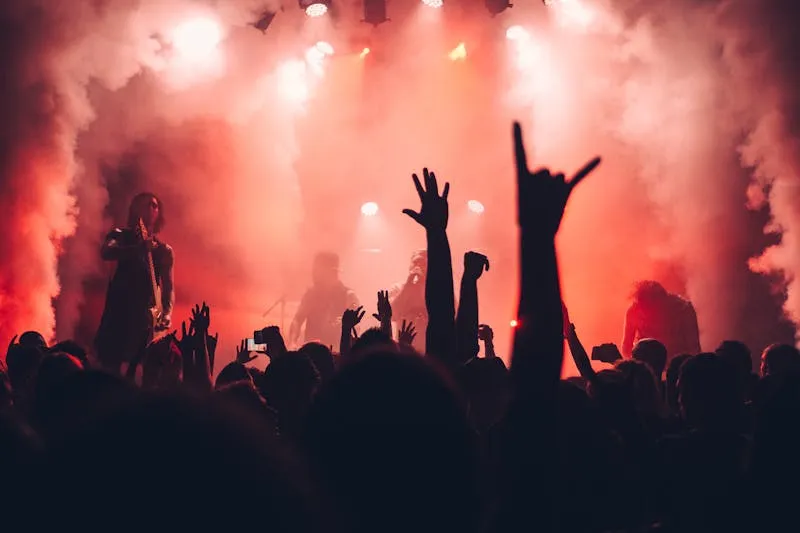
Last Saturday, I watched Eurovision at my friend Pauline's with 14 people, 7 flags, 3 bottles of prosecco, and a post-it betting system that nearly caused a diplomatic incident when Marc called Moldova "a country that doesn't even exist." By midnight, we were screaming the results as if our lives depended on it. By 1am, we were all on YouTube rewatching Finland's performance on loop. By 2am, someone was crying — I can't remember why.
That's Eurovision. The world's most-watched music competition (163 million viewers in 2024), the oldest (since 1956), the most absurd (a man dressed as a wolf singing hardstyle — who wins), and paradoxically the most unifying. Because Eurovision isn't really about music. It's a geopolitical spectacle — camp, excessive, sincere and ironic simultaneously — and nothing else on Earth comes close.
You don't understand the rules? Don't know why Australia competes? Wonder why the UK keeps getting nul points? This guide is for you.
From origins to today — 70 years of organised madness

Eurovision was born in 1956 in Lugano, Switzerland, from a simple and slightly mad idea: use television — then cutting-edge technology — to unite European peoples through song. We're in the depths of the Cold War, Europe is split in two, and the European Broadcasting Union (EBU) needs a format that can be broadcast simultaneously across multiple countries.
First edition: 7 countries, 14 songs, zero sequins. Switzerland wins with "Refrain" by Lys Assia — a song you've never heard of (nobody has). The format is austere: one singer, one orchestra, one microphone. No choreography, no pyrotechnics, no 40-metre LED walls.
The evolution mirrors European pop culture itself:
- 1960s-70s: the classic golden age. Songs in French, Italian, Dutch. ABBA wins in 1974 with "Waterloo" — the moment Eurovision transforms from a chanson contest to a potential launchpad for global stardom
- 1980s-90s: the kitsch era. Synthesizers invade, choreography becomes mandatory, camp reigns. Céline Dion wins for Switzerland in 1988 (yes, Switzerland)
- 2000s: eastern expansion. Former Soviet bloc countries join, disrupt voting dynamics, and bring a stage energy that transforms the show
- 2010s-2020s: the total spectacle era. Multi-million stage budgets, LED walls, pyrotechnics, drone shows. The contest attracts serious artists. Måneskin (Italy, 2021) becomes a global act. Eurovision is cool — for the first time in its history
How it works — the voting system decoded
Eurovision's voting system is a masterpiece of European bureaucratic complexity. Brace yourself.
Semi-finals. Since 2004, there are too many participating countries (37 in 2024) for a single night. Two semi-finals (Tuesday and Thursday) precede the Saturday grand final. 10 countries qualify from each semi = 20 qualifiers. The "Big Five" (France, Germany, UK, Spain, Italy) + the host country qualify automatically — because they fund the bulk of the EBU budget. Yes, it's unfair. No, it's not changing.
The voting. Each country awards two sets of points:
- National jury (5 music professionals) awards 1, 2, 3, 4, 5, 6, 7, 8, 10, and 12 points to its top 10 songs
- Televote (the public) awards the same point scale
Both scores are combined. A country CANNOT vote for itself. Jury results are announced country by country (the dramatic sequence: "And the United Kingdom gives twelve points to…"), then televote results are added in one go at the end — creating artificial but terribly effective suspense.
The 10 most iconic moments in Eurovision history

1. ABBA — "Waterloo" (1974). The founding moment. Four Swedes in sequinned costumes singing about Napoleon and love. The world discovers ABBA. Eurovision discovers it can produce global superstars.
2. Dana International — "Diva" (1998). First transgender artist to win Eurovision. Dana International's victory for Israel sparked ultra-orthodox protests in Jerusalem and celebrations in LGBTQ+ communities worldwide.
3. Lordi — "Hard Rock Hallelujah" (2006). Finland sends a hard rock band in monster costumes. Europe votes massively for them. The BBC received hundreds of complaints from shocked viewers. Lordi responded by posing with their masks next to the trophy.
4. Conchita Wurst — "Rise Like a Phoenix" (2014). An Austrian artist in an evening gown and full beard. Vocally flawless. The victory triggered a continental debate on gender identity and inclusion.
5. Måneskin — "Zitti e buoni" (2021). Rock returns and wins. Four Italians in leather and eyeliner playing real rock on a stage dominated by pop for 20 years. They became the first Eurovision act to reach a billion Spotify streams.
6. Salvador Sobral — "Amar pelos dois" (2017). Portugal wins for the first time in 53 participations — with an acoustic Portuguese ballad. No pyrotechnics, no choreography. Just a guy in an ill-fitting suit singing a love song his sister wrote. Sobral received a heart transplant 6 months later.
7. The UK — "Cry Baby" by Jemini (2003). Eurovision's most humiliating moment. The British duo sings horrifically out of tune — live in front of 100 million people. Result: nul points. The performance became a case study in what not to do.
8. Verka Serduchka — "Dancing Lasha Tumbai" (2007). Ukraine sends a comedic drag character in a silver star costume singing a mix of English, Ukrainian, and gibberish. Absurd, joyful, irresistible. 2nd place.
9. Loreen — "Euphoria" (2012 and 2023). The only artist to win twice solo. "Euphoria" is considered by many as the greatest Eurovision song ever — a perfect dance-pop anthem.
10. The UK — Sam Ryder, "Space Man" (2022). The UK's redemption. After years of bottom-five finishes, Sam Ryder's soaring vocals earned 2nd place — the UK's best result in over 20 years. Proof that sending a genuinely talented artist who actually wants to be there changes everything.
The scandals that shook the contest
The 2018 stage invasion. During UK singer SuRie's performance in Lisbon, a man jumped on stage, grabbed her microphone and shouted a political message. SuRie grabbed the mic back and finished her song — earning universal respect.
The Måneskin drug scandal (2021). Damiano David was filmed leaning over a table during results. Social media exploded: "he's doing drugs on live TV!" The EBU requested a drug test. Result: negative. Damiano was picking up a broken glass. The incident became a global meme and paradoxically boosted the band's visibility.
Australia — why does it compete? Not a scandal but the most-asked question. Australia was invited in 2015 because Eurovision has been broadcast there since the 80s and is culturally massive (the country wakes at 5am to watch the final). The "one-off" invitation became permanent.
The UK at Eurovision — a complicated love story
The UK is one of Eurovision's founding participants (since 1957) and has won 5 times — most recently in 1997 with Katrina and the Waves. Since then, the story has been one of disappointment, questionable song choices, and Brexit-era angst.
The UK problem: for years, the internal selection sent artists who didn't particularly want to be there (viewing Eurovision as "beneath them"), songs that tried too hard to be "continental," and underfunded staging. The cultural British disdain for Eurovision — "it's naff" — became a self-fulfilling prophecy: you disrespect the contest, you send mediocre entries, you finish last, you disrespect it even more.
The turning point? 2022, Sam Ryder. The BBC finally understood: send an artist who genuinely WANTS to be there, a strong song, and staging that competes with the best. Result: 2nd place, critical adoration, national pride restored.
The geopolitics of voting — blocs and alliances

Eurovision is often described as "geopolitics with sequins." It's not entirely wrong.
Historic blocs:
- Nordic bloc: Sweden, Norway, Denmark, Finland, Iceland vote for each other — but not blindly. Sweden wins often because it invests massively in quality pop, not just because Norway gives it 12 points
- Balkan bloc: ex-Yugoslav countries support each other — often through diaspora voting
- Former Soviet bloc: geopolitical alliances and rivalries directly transposed onto the scoreboard
- Greece-Cyprus axis: the most predictable bloc. 12-point exchanges are near-systematic
But the picture is more nuanced. The 50/50 televote introduction has reduced bloc impact. And recent big winners — Sweden, Italy, Ukraine, Switzerland — aren't countries "helped" by massive blocs. They win because they send great songs with spectacular staging.
Throwing the perfect Eurovision watch party

Eurovision is a group activity. Watch it alone and you miss 50% of the experience. Here's how to throw the perfect party — tested and refined over 8 editions.
The betting grid. Print a grid with all participating countries. Each guest bets on the top 5 before the show starts. Symbolic stake: €5. The pot goes to the winner. Advanced variant: each guest draws a country at random and must "support" it all evening — including standing and applauding during its performance.
Eurovision bingo. Create bingo cards with squares like: "costume change on stage," "sustained high note," "chair choreography," "fire on stage," "the commentator says something sarcastic," "12 points from Greece to Cyprus." First to fill their card wins an improvised trophy.
Country-themed buffet. Each guest brings a dish or drink from a country of their choice. Tapas for Spain, falafel for Israel, meatballs for Sweden, baklava for Turkey. Culinarily questionable but socially infallible.
Frequently Asked Questions About Eurovision
Why do Israel and Australia compete in Eurovision?
Eurovision is organised by the EBU (European Broadcasting Union), not the EU. Membership is open to any EBU member broadcaster — which includes countries across the Mediterranean and beyond. Israel has competed since 1973 through its broadcaster IBA (now KAN). Australia was invited in 2015 as an "associate participant" due to the contest's massive popularity there — the invitation became permanent. Morocco competed once (1980).
How much does hosting Eurovision cost?
Between €30 and €60 million depending on production scale. The host country bears the majority of costs. The EBU contributes roughly €7 million. The return on investment comes through tourism (host cities see a 20-40% increase in tourist visits during the event month) and broadcast rights (40+ channels worldwide). But it's a financial black hole for small countries — explaining the occasional panic from certain winners.
Can artists sing in any language?
Yes, since 1999. Before that, rules required singing in a national language. Since 1999, complete linguistic freedom applies — and English dominates (roughly 70% of entries). But non-English winning songs — "Amar pelos dois" in Portuguese (2017), "Zitti e buoni" in Italian (2021), "Stefania" in Ukrainian (2022) — are often the most memorable.
Can the UK still win?
Absolutely — and it proved it can compete with Sam Ryder's 2nd place in 2022. The UK has the resources, the artistic talent pool, and (since the BBC's strategic reset) the institutional will. The key: a charismatic artist who genuinely wants to be there, a strong song, and staging that rivals the best. The UK's historical problem was never ability — it was attitude.
How do you vote in Eurovision?
During the final (and semi-finals), you can vote by SMS or via the official Eurovision app (free). Each country has a dedicated number (shown on screen during the voting window). You can vote up to 20 times — for one or several different countries. SMS costs vary by operator (typically £0.50-1). You CANNOT vote for your own country. Voting is open for approximately 15 minutes after the last performance.