
The other day, my friend Margaux sent me a photo of her wardrobe in full disaster mode. Doors flung open, clothes piled in chaos, three drawers that no longer close, and this message: "I have 147 pieces in my wardrobe and I always wear the same 12." I laughed, then counted my own. 189. Including a dress bought for a wedding in 2019 that I've never worn again. A blazer "for when I'm invited onto a TV panel." Three pairs of jeans kept "just in case" they fit again. We all have this problem — and the solution isn't buying more, it's buying better. Much, much better.
The capsule wardrobe is a concept that sounds simple but demands real thought. The idea: reduce your wardrobe to a limited number of carefully chosen pieces that all combine with each other. Not 300 garments of which you wear 10%, but 30 to 40 pieces of which you wear 100%. And no, it doesn't mean dressing in beige every day. Promise.
In this article
- What exactly is a capsule wardrobe?
- Why it's life-changing (beyond mornings)
- The big declutter: the method that works
- Essential basics: the complete list
- Building your colour palette
- The art of infinite combinations
- Adapting your capsule to the seasons
- Budget and cost-per-wear: the financial argument
- The 7 mistakes that sabotage your capsule
- Frequently asked questions
What exactly is a capsule wardrobe?
The term was coined by Susie Faux, owner of the London boutique "Wardrobe," in the 1970s. Her idea: a collection of essential, timeless pieces kept season after season, complemented by a few trend pieces that evolve. The concept was repopularised in 2010 by Caroline Joy Rector with her blog "Un-Fancy," then in 2015 by Courtney Carver with her "Project 333" challenge — 33 pieces for 3 months.
But a capsule wardrobe is NOT:
- A sad, monochrome uniform
- A punitive restriction of your sartorial freedom
- An excuse to rebuy your entire wardrobe in one go (the supreme irony)
- An extreme minimalism contest ("look, I only have 15 pieces!")
It's really an intentional curation. You keep what you genuinely love, what genuinely suits you, what works with the rest of your wardrobe. And you let the rest go — without guilt, without drama.

The magic number: Most experts agree on 30 to 40 pieces per season (clothing only, not counting underwear, sleepwear, and sportswear). But it's a guideline, not a commandment. Some capsules work with 25 pieces, others with 50. What matters is that EVERY piece gets worn regularly.
Why it's life-changing (beyond mornings)
If the capsule wardrobe were just about a tidy cupboard, it wouldn't have won over millions of people. The benefits go far beyond saving space.
Decision fatigue: the silent drain
Every morning, faced with your bursting wardrobe, you make dozens of micro-decisions: these jeans or those? Does this top go with that skirt? Is it too dressy for the office? Research in cognitive psychology (notably Barry Schwartz's work on the "Paradox of Choice") shows that abundance of choice doesn't make us freer — it paralyses us. With a capsule wardrobe, you go from "I have nothing to wear despite 150 options" to "everything works together, I choose in 3 minutes." The difference is extraordinary.
The environmental impact (the numbers that hurt)
The fashion industry is the second most polluting industry in the world. According to WRAP UK:
- The average UK adult has £30 billion worth of unworn clothing in their wardrobes
- 30% of clothing in the average wardrobe hasn't been worn in at least a year
- A single pair of jeans requires 7,500 litres of water to manufacture
- The textile industry emits 1.2 billion tonnes of CO2 annually
Reducing your clothing consumption isn't a symbolic gesture — it's one of the most impactful individual actions you can take.
The financial argument (the most convincing)
According to the ONS, the average UK household spends around £1,000–1,700 per year on clothing. A significant portion ends up unworn or barely used. With a capsule approach, you spend less in quantity but more on quality — and the cost-per-wear plummets. I'll get into the details in the budget section.
Warning: If your capsule wardrobe becomes a source of anxiety or guilt with every purchase, you've tipped into punitive minimalism. The goal isn't perfection — it's wardrobe serenity. Buy the occasional impulse piece, the planet won't stop spinning.
The big declutter: the method that works
This is the most dreaded part — and the most liberating. Here's my 4-step method, tested on my own wardrobe (and on Margaux's, after she made me swear I'd help).
Step 1: Take everything out
Yes, everything. Every garment, every accessory, every "but I might wear it someday." Spread it all across your bed. It's visually shocking — that's the point. When you physically see the quantity, the penny drops immediately.

Step 2: The 4 make-or-break questions
For each piece, ask yourself:
- Have I worn it in the last 12 months? No → "leaving" pile (except occasion wear)
- Does it fit me TODAY? Not "when I've lost half a stone" or "when I get the chance." Today.
- Is it in good condition? Pilling, stained, stretched → leaving (unless repairable)
- How many other pieces in my wardrobe can I wear it with? Fewer than 3 → it's stranded and taking up space for nothing
Step 3: The three piles
- "Keep" pile — pieces that pass all 4 questions
- "Sell/donate" pile — in good condition but no longer for you (Vinted, Depop, charity shops)
- "Recycle" pile — too worn to be donated (textile recycling banks, H&M in-store take-back)
Step 4: The inventory
Count what remains. Note each piece in a spreadsheet or app (Cladwell, Stylebook, or a simple Google Sheets). Categorise: tops, bottoms, dresses, jackets, shoes, accessories. You'll immediately spot gaps and duplicates.
The reverse hanger trick: If you can't decide on certain pieces, turn their hangers backwards. After 3 months, those still reversed haven't been worn — the decision makes itself.
Essential basics: the complete list
Here's the backbone of any self-respecting capsule wardrobe. This list is a starting point — adapt it to your lifestyle, climate, and personal taste.

Tops (10–12 pieces)
- 2–3 white t-shirts (crew neck AND v-neck — yes, both count)
- 2 coloured t-shirts (in your palette — we're getting there)
- 1 classic white shirt
- 1 denim or chambray shirt
- 1 dressy blouse
- 2 jumpers (1 fine knit, 1 chunkier cable or ribbed)
- 1 sweatshirt or hoodie for "off" days
Bottoms (5–6 pieces)
- 1 dark wash straight-leg jeans (the single most versatile wardrobe piece)
- 1 black or dark grey jeans
- 1 tailored trousers (black, navy, or camel)
- 1 midi skirt (the most flattering and versatile length)
- 1 shorts or bermudas (summer)
- 1 wide-leg or palazzo trousers (optional but endlessly useful in summer)
Dresses (2–3 pieces)
- 1 versatile black dress (the famous LBD)
- 1 casual day dress (cotton, linen, or jersey)
- 1 printed or colourful dress (your capsule's "joy piece")
Jackets and coats (4–5 pieces)
- 1 structured blazer (black, navy, or camel)
- 1 denim jacket
- 1 trench coat or mac
- 1 winter coat (depending on your climate)
- 1 lightweight transitional jacket (leather biker, bomber, or shacket)
Shoes (5–6 pairs)
- 1 pair white trainers (the Stan Smiths of life)
- 1 pair ankle boots (black or tan)
- 1 pair loafers or brogues
- 1 pair flat sandals
- 1 pair dressy shoes (courts, Mary Janes, or heeled mules)
- 1 pair wellies (because British weather)
Accessories (5–8 pieces)
- 1 everyday bag (medium size, neutral colour)
- 1 small evening bag
- 1 leather belt
- 1 silk scarf
- 1–2 signature jewellery pieces (the ones you put on without thinking)
- 1 pair sunglasses
Total: roughly 35–40 pieces. With these, you cover 95% of your life's situations — from the office to Sunday brunch to dinner with the in-laws.
Building your colour palette
This is THE key to a capsule that works. If your colours aren't cohesive, your pieces won't combine — and you'll end up buying more "because nothing goes together."
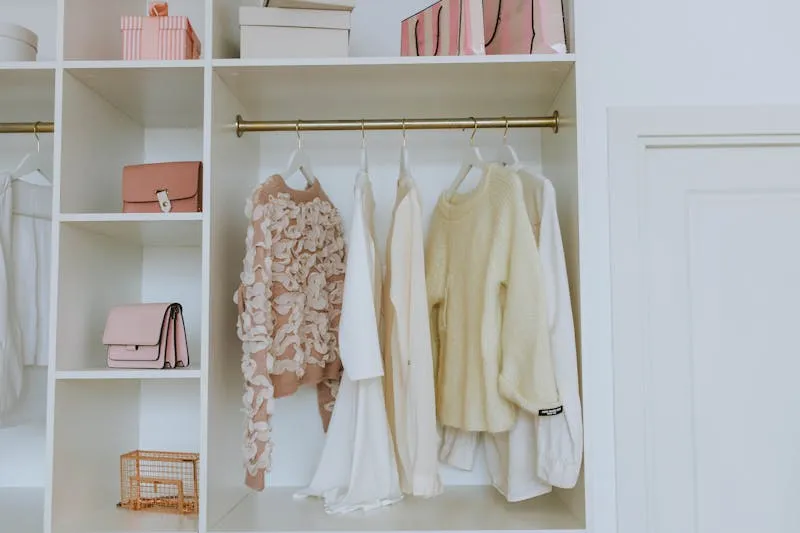
The 3+3 formula
Choose:
- 3 neutral colours that form the base of your wardrobe. The classics: black, white, grey, navy, beige, camel, khaki. These are the colours of your bottoms, jackets, and basics.
- 3 accent colours that bring personality. The colours that make your heart sing — rust red, royal blue, forest green, burgundy, mustard, terracotta. They'll appear in your tops, dresses, and accessories.
The golden rule: each accent colour must work with at least 2 of your neutral colours. If your burgundy only works with black but not with camel or grey, it creates limited combinations.
Finding YOUR colours
Colour analysis (seasonal colour theory) can help, but don't lock yourself in. The best method: hold the garment under your face in front of a mirror, in natural light. If your complexion brightens, it's your colour. If you look washed out, it isn't — regardless of what Pinterest says.
Ultimate test: Photograph yourself wearing the item in question with your phone flash. Colours that don't suit you leap off the screen in photos — far more revealing than the changing room mirror with its flattering lighting.
The art of infinite combinations
A well-built 37-piece capsule can generate over 200 different outfits. Yes, two hundred. The secret? Modularity.

The 1 × 3 rule
Every new piece added to your capsule must pair with at least 3 pieces already in it. If it only works with one pair of trousers or one jacket, it has no place in the capsule — it's an orphan purchase that will take up space without earning its keep.
Combinations by occasion
Office / professional: blazer + white shirt + tailored trousers + loafers = effortless chic. Next day, same blazer + white t-shirt + dark jeans + white trainers = perfect smart casual.
Casual weekend: sweatshirt + jeans + white trainers. Or t-shirt + midi skirt + flat sandals. The possibilities are endless when the palette is cohesive.
Evening: dressy blouse + black trousers + courts + signature jewellery. Or LBD + denim jacket + ankle boots = the right balance of sophisticated and relaxed.
Travel: the capsule wardrobe IS your suitcase. 10–12 pieces that all combine = 7 days of outfits without thinking. This is actually how many people discover the concept in the first place.
The power of accessories
A silk scarf transforms jeans + white t-shirt into Parisian chic. A belt changes the silhouette of a dress. Statement earrings elevate a minimal look. Accessories are the most underestimated outfit multiplier in the capsule wardrobe toolkit.
Adapting your capsule to the seasons
The capsule wardrobe isn't fixed — it breathes with the seasons. The most practical approach: a permanent core of 25–30 pieces, complemented by 8–10 seasonal pieces that rotate in and out.

The permanent core (year-round)
Dark wash jeans, black trousers, basic t-shirts, white shirt, blazer, white trainers, everyday bag. These pieces never leave — they form the backbone of your style.
Spring-summer rotation
In: light dresses, sandals, shorts, linen shirt, sunglasses. Out: winter coat, chunky knits, boots.
Autumn-winter rotation
In: knit jumpers, winter coat, wool scarf, ankle boots, opaque tights. Out: summer dresses, sandals, shorts.
Off-season storage
Off-rotation pieces should be stored clean, folded (not hung — especially knitwear, which stretches on hangers) in boxes or garment bags. Add a lavender sachet to ward off moths. Proper storage extends the life of your clothes by several years.
Classic trap: Don't use the seasonal rotation as an excuse to "just add 2 or 3 little things." That's how capsules inflate season after season. The rule: one piece in, one piece out. No negotiation.
Budget and cost-per-wear: the financial argument
This is the section that convinces even the biggest sceptics — because maths doesn't lie.

Cost-per-wear (CPW)
It's the purchase price divided by the number of times you wear the garment. Example:
- Primark t-shirt at £5 worn 5 times → CPW = £1
- Organic cotton t-shirt at £35 worn 80 times → CPW = £0.44
- Cocktail dress at £120 worn twice → CPW = £60
- Levi's 501 jeans at £95 worn 200 times → CPW = £0.48
The cheapest item at point of purchase is almost never the cheapest in use. It's counterintuitive, but proven: investing in quality saves money in the long run.
A realistic capsule budget
Building a complete capsule from scratch costs between £600 and £2,000 depending on your brand choices. Sounds steep, but remember:
- You're already spending £1,000–1,700/year on clothes, most of which you barely wear
- A well-built capsule lasts 3–5 years (quality basics survive)
- The amortised cost works out to £150–400 per year — less than your current spend
Budget strategy: Don't build your capsule in a single shopping trip. First declutter, identify the gaps, then acquire missing pieces gradually over 3–6 months — taking advantage of sales, secondhand (Vinted, Depop, Vestiaire Collective, charity shops), and end-of-line stock. Patience is your wallet's best friend.
Where to invest, where to save
Invest in: shoes (your feet will thank you), jeans (a good pair lasts 5+ years), your coat (it's the first thing everyone sees), the blazer (the piece that elevates everything).
Save on: basic t-shirts (Uniqlo, COS on sale), trend accessories (they change every season), sportswear (it wears out quickly regardless).
The 7 mistakes that sabotage your capsule
I made at least 5 of these 7 when building my first capsule. Learn from my blunders.
1. Purging everything in one minimalism-fuelled burst
Mistake number one. You watch a motivational YouTube video, ditch half your wardrobe, and three weeks later you're buying replacements because you've got nothing to wear. The declutter should be gradual and considered, not impulsive.
2. Copying someone else's capsule
That Californian blogger's capsule is perfect — for her, in Los Angeles, with her lifestyle. Your capsule must reflect YOUR life: your climate, your work, your body, your taste. Be inspired, but never copy.
3. Buying too many neutrals, not enough personality
A 100% black-white-grey wardrobe is functional but dreary. Accent colours are what keep you from getting bored. Two or three pieces with character transform a monotone wardrobe into something that feels like you.
4. Ignoring your actual lifestyle
If you work from home 4 days out of 5, your capsule doesn't need 5 office outfits. If you go dancing every weekend, include some party pieces. Build the capsule for the life you live, not the one you fantasise about.
5. Neglecting garment care
A £200 cashmere jumper washed at 60°C is a destroyed cashmere jumper. Read labels, invest in a mesh laundry bag, learn to spot-treat stains. Care is what separates a capsule that lasts 1 year from one that lasts 5.
6. Forgetting sub-categories
The capsule wardrobe doesn't cover underwear, sleepwear, sportswear, or technical clothing (ski kit, hiking gear). These are separate categories with their own needs. Don't count them in your 37 pieces.
7. Being too rigid
The capsule isn't a prison. If you fall for a leopard print on sale and it makes you smile every time you wear it, keep it. Wardrobe joy has its place in an intentional closet too.
Frequently asked questions
How many pieces should an ideal capsule wardrobe have?
Between 30 and 40 pieces (excluding underwear, sleepwear, and sportswear) is the expert consensus. Courtney Carver's Project 333 proposes 33 pieces for 3 months, shoes and accessories included. But the exact number matters less than the principle: every piece should be worn regularly and pair with at least 3 others.
Do I need to buy everything at once?
Absolutely not. Start by curating what you already own — you'll be surprised how much of your capsule already exists. Then identify the gaps and fill them gradually over 3–6 months. This approach is better for your budget AND gives you time to find exactly the right pieces.
Does the capsule wardrobe work for plus sizes?
Absolutely yes. The concept is size-independent — it's based on colour coherence, fabric quality, and piece combinability. The only difference concerns brands: prioritise those with genuine plus-size pattern-making (not just scaled-up standard models). Brands like Universal Standard, and extended lines from COS, &Other Stories, and Arket offer quality basics in inclusive sizing.
How do I handle specific work clothing (uniforms, scrubs)?
Mandated work clothing doesn't belong in the capsule — it's in a category of its own, like sportswear. Your capsule covers your personal time and the moments when you choose what to wear. If you have a strict dress code at work, focus your capsule on off-duty life and build a separate mini professional wardrobe.
Can I build a capsule wardrobe on a tight budget?
Yes, and it's actually one of its greatest advantages. Secondhand shopping (Vinted, Depop, Vestiaire Collective, charity shops) lets you find quality basics at a fraction of the price. A pre-owned pair of Levi's 501s costs £12–20 instead of £95. A Zara blazer in good condition can be found for £8. Invest in quality gradually — start with the most-worn pieces (jeans, shoes) and upgrade as you replace.
Do I completely ignore trends?
Not necessarily. The capsule wardrobe distinguishes timeless basics (70–80% of your wardrobe) from trend pieces (20–30%). You can integrate one or two trend pieces per season — provided they harmonise with your palette and basics. The idea is to ride trends that you genuinely love without rebuilding your entire wardrobe every season.