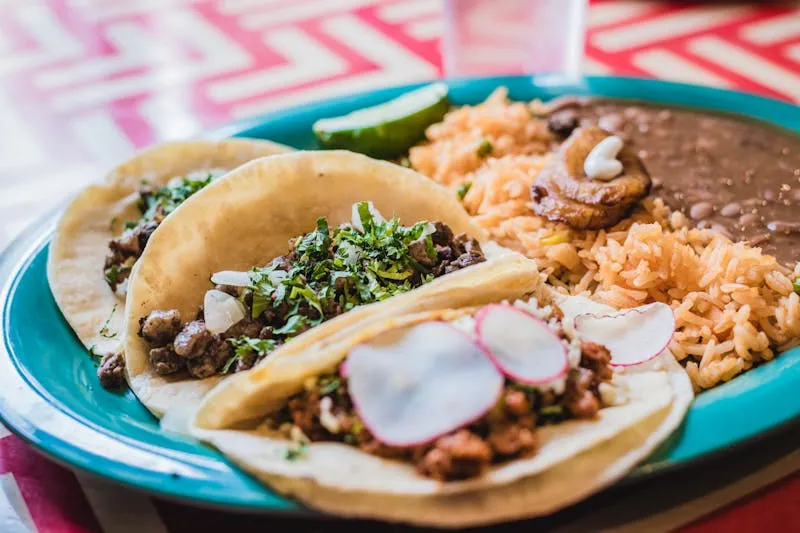
A Saturday evening in February 2020, in Oaxaca, southern Mexico. I'm sitting on a plastic stool in a night market, opposite a woman of about seventy who's making tlayudas — large crispy corn tortillas topped with asiento (rendered pork fat), black beans, Oaxaca cheese, and chapulines. Chapulines. Grasshoppers, toasted with lime and chilli. I ate them. They were excellent — crispy, slightly smoky, with a nutty flavour that had nothing weird about it.
But it wasn't the grasshoppers that stayed with me. It was the tortilla. That hand-made corn tortilla was a fundamentally different food from anything I'd ever called "tortilla" back home. The taste of the corn — deep, earthy, almost smoky — bore no resemblance to the beige plastic discs from the supermarket. That tortilla was an ingredient, not a wrapper.
That evening, I understood that what I'd known as "Mexican food" — nachos drowning under melted cheddar, giant burritos stuffed with rice, chicken fajita kits — had approximately nothing Mexican about it. It was Tex-Mex: a cuisine born on the Texas border, delicious in its own right, but as distant from the cooking of Oaxaca or Puebla as frozen pizza is from Naples.
This article is the one I wish I'd read before that trip. An introduction to real Mexican cooking — its ingredients, its techniques, its foundational recipes — for anyone who fancies going beyond nachos.
In this guide
Tex-Mex vs Mexican: the worldwide misunderstanding
Before cooking Mexican, you need to understand what isn't. Tex-Mex is a fascinating cuisine in its own right — born in Texas in the 19th century from the meeting of Mexican traditions and American ingredients. But the confusion between the two is a problem, because it masks the staggering richness of real Mexican cooking.
What's Tex-Mex (not Mexican):
- Nachos (invented in Piedras Negras, on the border, in 1943)
- Melted yellow cheddar on everything (in Mexico, they use queso fresco, queso Oaxaca, or queso Chihuahua)
- Hard-shell tacos (crunchy industrial shells — in Mexico, tacos are ALWAYS on soft tortillas)
- Fajitas (the concept of "grilled meat + peppers + onions on flour tortilla" is Texan)
- The giant burrito (which exists in Mexico but only in the north — Chihuahua and Sonora — nowhere else)
- Chilli con carne (originated in Texas, not Mexico)
- Sour cream — in Mexico, they use crema mexicana, thinner and less tangy
What's authentically Mexican:
- Tacos on soft corn tortillas, filled with a single type of meat, raw onion, coriander, and a salsa
- Moles — complex sauces of 20 to 30 ingredients, cooked for hours
- Tamales — corn dough stuffed, steamed in a corn husk or banana leaf
- Chiles rellenos — chillies stuffed with cheese or meat, battered and fried
- Pozoles, menudos, birrias — rich, festive soups and stews
- Nixtamalized corn — the founding process of all Mesoamerican cuisine
Kristina's tip — In 2010, traditional Mexican cuisine was inscribed on UNESCO's Intangible Heritage list — the first national cuisine to receive this honour (alongside French cuisine, the same year). It wasn't tacos or burritos that were honoured. It was the complete food system: the milpa (growing corn, beans, and squash together), nixtamalization, the markets, and family transmission.
The fundamental ingredients
Mexican cooking is built on a millennial triad: corn, beans, and chillies. These three ingredients are the foundation of Mesoamerican civilisation — the Aztecs, the Maya, and before them the Olmecs cultivated them together in an agricultural system called the milpa.
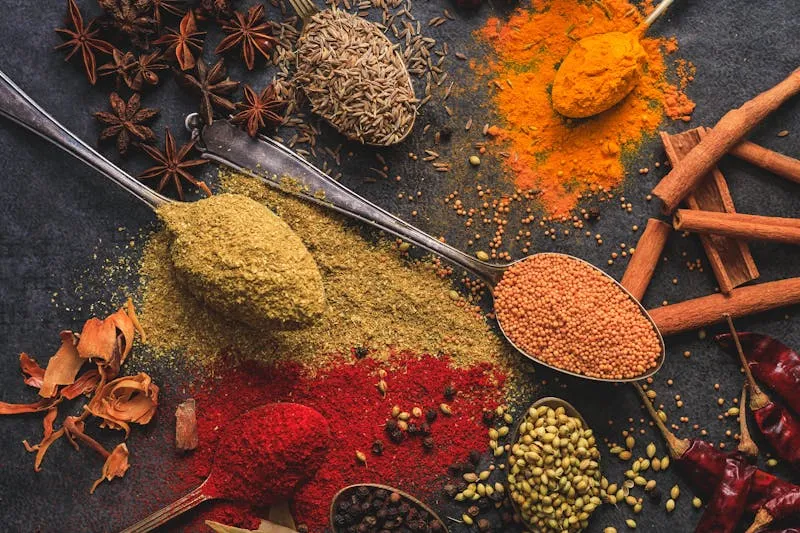
Corn — It's not a side dish. It's THE foundation. Mexico has over 60 varieties of native corn, in every colour — white, yellow, blue, red, black. Corn is transformed into tortillas, tamales, atole (hot drink), pozole, gorditas, sopes, tlacoyos. The technique of nixtamalization (soaking in lime water) transforms corn into masa — the dough that makes everything. This 3,500-year-old process makes corn more nutritious (releases niacin, improves protein absorption) and gives it its characteristic flavour.
Beans (frijoles) — Black in the south (Oaxaca, Veracruz, Yucatán), pinto in the north (Chihuahua, Sonora). Always slow-cooked, often "refried" (frijoles refritos — poorly translated: "refritos" means "well-cooked," not "fried twice"). Beans + corn form a nutritionally complete pairing — together, they provide all essential amino acids.
Chillies (chiles) — Not just "heat." Each chilli has a distinct flavour profile. Mexico has over 150 chilli varieties. They're ingredients, not condiments.
The world of Mexican chillies
This is where Mexican cooking reveals its true depth. Chillies aren't there to "make things spicy." They're there for flavour — each variety brings a unique aromatic profile that structures a dish.
Fresh chillies:
- Jalapeño — The most famous. Moderately hot (2,500–8,000 Scoville). Fleshy, bright green. Used in fresh salsas, nachos (yes, even Tex-Mex uses it). Smoked and dried, it becomes the chipotle.
- Serrano — Smaller and hotter than jalapeño (10,000–25,000 Scoville). Thinner skin, firm flesh. The chilli for salsa verde.
- Poblano — Large, dark green, very mild (1,000–2,000 Scoville). The stuffing chilli (chiles rellenos). Roasted, it develops a sweet, smoky flavour. Dried, it becomes the ancho.
- Habanero — The volcano. 100,000–350,000 Scoville. Native to the Yucatán, fruity and floral beneath the nuclear heat. Used sparingly in southern Mexican salsas.
Dried chillies (the magic):
- Ancho — Dried poblano. Sweet, fruity (prune, raisin), mildly hot. The base of red mole and adobo. The most used dried chilli in Mexico.
- Guajillo — Long, smooth, dark red. Moderately hot, fruity (cranberry), with green tea notes. The base of meat adobo (birria, carne adobada).
- Chipotle — Smoked, dried jalapeño. Smoky, earthy, moderately hot. Most often tinned (chipotles en adobo). 1–2 chipotles transform a dish.
- Pasilla — Long, thin, black. Mild, with notes of cocoa and liquorice. Used in Oaxacan mole negro.
- Árbol — Small, thin, bright red. Very hot (15,000–30,000 Scoville) and clean (without too much aromatic complexity). The base of the red taquera salsa found at every taco stand.
Warning — Dried chillies must be rehydrated and often toasted before use. The technique: dry-toast them in a pan (30 seconds per side, until they soften and release aroma), then soak in hot water for 15–20 minutes. Blend with the soaking liquid for a sauce. DO NOT discard the soaking water — that's where the flavour concentrates.
The corn tortilla: it all starts here
The corn tortilla is to Mexican cooking what bread is to French cuisine. But unlike bread, it's made by hand every day, often several times a day, in millions of households.
Homemade corn tortillas:
You need one single ingredient: masa harina (nixtamalized corn flour). The most widely available brand is Maseca — found in Latin American shops or online. This is NOT polenta, NOT cornmeal. It's lime-treated corn, dried and ground.
- Mix 200 g masa harina with 250–280 ml warm water and a pinch of salt. Knead for 2 minutes — the dough should be pliable like playdough, neither sticky nor crumbly.
- Divide into 12–14 golf-ball-sized balls.
- Flatten each between two sheets of baking paper using a heavy flat surface (a frying pan, chopping board, book) or — if you want to invest — a tortilla press.
- Cook each tortilla on a dry pan (no oil!) over high heat, 1 minute per side. It should puff slightly — that's the sign it's properly cooked and the dough has the right hydration.
- Keep warm stacked in a clean tea towel.
Total: 20 minutes for 12 tortillas. The flavour is incomparable with the industrial product — earthy, strong corn taste, with a pliable texture that folds without cracking.
Kristina's tip — If the dough sticks to the baking paper, it's too wet: add a bit more masa harina. If it cracks at the edges when you press, it's too dry: add a splash of water. The right texture is found in 30 seconds of adjustment — it's more intuitive than it sounds.
Salsas: the backbone of Mexican cooking
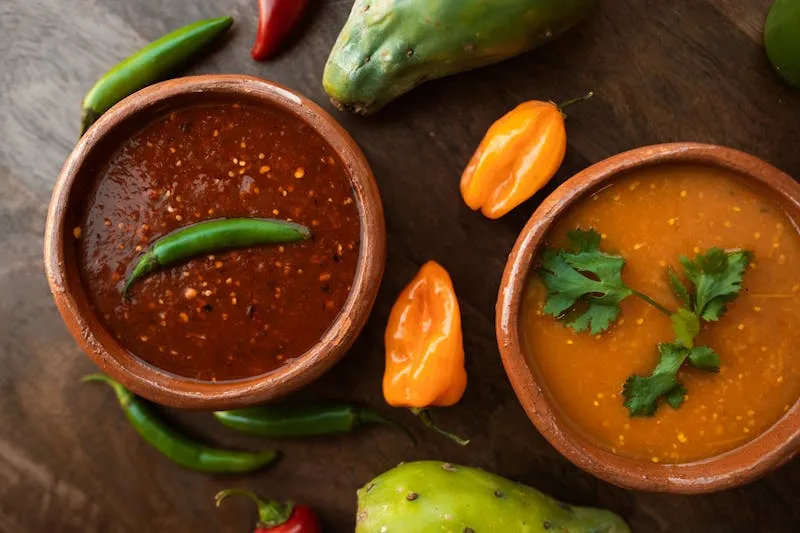
In Mexico, a salsa isn't a "side." It's the primary seasoning of the meal. Every taco stand has its own salsas, every family its own recipes. There are hundreds of variations, but here are the three fundamentals.
1. Salsa roja (cooked red salsa)
4 tomatoes + 2 rehydrated guajillo chillies + 1 árbol chilli + 2 garlic cloves + 1/4 onion — all dry-roasted in a pan until the tomatoes are blackened in spots. Blend with a little chilli soaking water, salt. The result is smoky, gently hot, with a depth that raw salsa doesn't have. This is the standard taqueria salsa.
2. Salsa verde (green salsa)
500 g tomatillos (fresh or tinned), 2 serrano chillies, 1/2 onion, 1 garlic clove, a handful of fresh coriander. Two versions: raw (everything in the blender, fresh and bright) or cooked (roast the tomatillos and chillies first, mellower and deeper). Salsa verde is more acidic and fresh than roja — it pairs perfectly with pork and chicken.
3. Pico de gallo (salsa fresca)
Diced tomatoes + finely diced white onion + chopped coriander + finely chopped serrano or jalapeño + lime juice + salt. No cooking. Made in 5 minutes. Pure freshness on a taco, in a burrito, or with totopos (tortilla chips).
4. Guacamole (essential bonus)
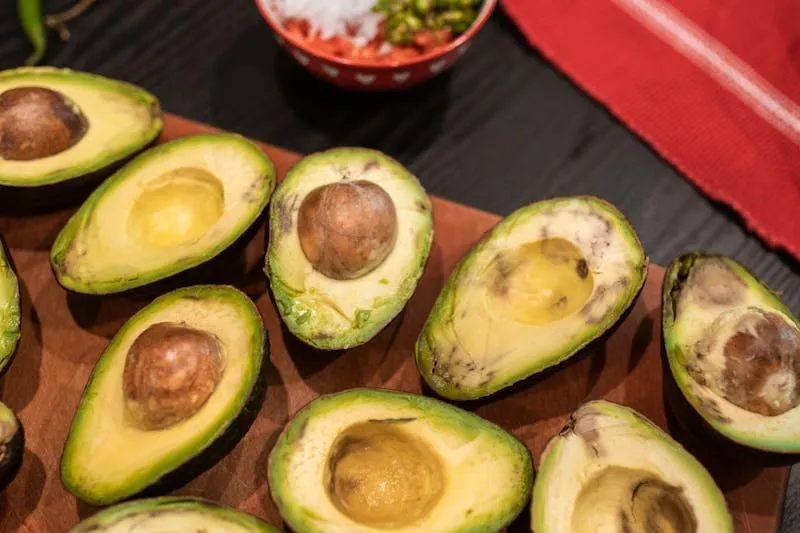
Real Mexican guacamole is almost provocatively simple. 2 ripe avocados roughly mashed (not smooth purée — you want chunks). 1/2 white onion, finely diced. 1 finely chopped serrano chilli (or jalapeño). Juice of 1 lime. Chopped fresh coriander. Salt. That's IT. No tomatoes (optional — some families add them, others don't). No cream. No garlic (controversial — some add it, purists say no). No cumin. No mayonnaise (yes, I've seen it; yes, I wept).
Kristina's tip — A ripe avocado for guacamole gives gently when you press the skin. Too hard = unripe (grassy flavour). Too soft = overripe (oxidised flavour, brown flesh). If your avocados aren't ripe, leave them at room temperature with a banana — the banana's ethylene gas accelerates ripening in 24–48 hours.
6 essential recipes — from street stall to family kitchen
1. Tacos al pastor — the king of tacos
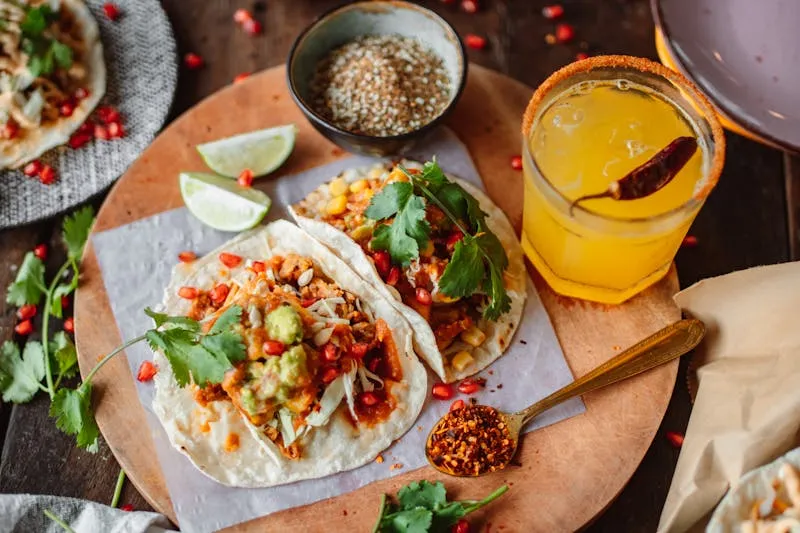
The backstory is incredible: tacos al pastor were born from Lebanese immigration to Mexico in the 1930s. The immigrants brought shawarma — marinated meat cooked on a vertical spit. The Mexicans swapped lamb for pork, added chillies and pineapple, and a classic was born.
Home version without a spit: marinate 500 g pork (shoulder, sliced thin) in an adobo — 3 guajillo + 2 ancho chillies, rehydrated and blended with 2 tbsp vinegar, 1 tsp cumin, 1 tsp oregano, 2 garlic cloves, 1 tbsp achiote (or smoked paprika), salt. Marinate 2 hours minimum (better: overnight). Grill or pan-fry on high heat, 2–3 minutes per side. Serve on corn tortillas with grilled pineapple, raw onion, coriander, and a squeeze of lime. The sweet-smoky-sour-spicy contrast is one of the finest flavours on earth.
2. Frijoles refritos (refried beans)
Frijoles are the cement of Mexican cooking — present at nearly every meal. Express version with tinned beans (purists soak and cook dried beans for 3 hours, but tinned is an honest shortcut).
Sauté 1/2 sliced onion in 2 tbsp lard (the traditional fat — oil works too but tastes different). When translucent, add 2 tins drained black beans. Roughly mash with a fork or masher — no blender, you want texture. Add stock or water for desired consistency. Salt, pepper, 1 tsp cumin. Cook 10 minutes, stirring. The result should be creamy with visible bean pieces.
3. Arroz rojo (Mexican red rice)
Mexican rice isn't steamed — it's fried first. Rinse 200 g long-grain rice. Dry well. Fry in 2 tbsp oil until the grains turn golden (3–4 min). Add 1/2 chopped onion, 1 garlic clove. 1 minute. Pour in 150 g blended tomatoes (or passata) + 350 ml stock. Salt, cumin. Bring to the boil, cover, lowest heat for 18 minutes. Rest 5 minutes. Fluff. The rice is red-orange, each grain separate, with a subtle tomato flavour.
4. Pollo en mole poblano (chicken in mole)
Mole poblano is Mexico's national dish. It's also the most complex — traditionally containing 25 to 30 ingredients including chillies, chocolate, almonds, sesame seeds, cinnamon, cumin, and burnt tortillas as thickener. Simplified but honest version:
Dry-toast 4 ancho + 2 guajillo + 2 pasilla chillies (30 sec/side). Rehydrate 20 min. In the same pan: 2 tbsp almonds, 2 tbsp sesame seeds, 1/2 torn tortilla — toast everything until golden. Blend with 1 roasted onion, 2 garlic cloves, 1 roasted tomato, 1 tsp cinnamon, 1/2 tsp cumin, 30 g dark chocolate (70%), 400 ml chicken stock. Strain through a sieve. Simmer gently 20 min. Pour over cooked chicken pieces (thighs or drumsticks). Serve with rice and tortillas. The mole is dark, rich, with a complexity that transports you — sweet, smoky, bitter, spicy, all at once.
Warning — Mole is NOT a spicy dish. Despite the number of chillies, the vast majority (ancho, pasilla) are mild and bring aromatic complexity, not fire. A well-made mole is deep and enveloping — if yours is hot, you probably used too many chiles de árbol or not enough chocolate and almonds to balance.
5. Elote (street corn)
Mexico's most iconic street snack. Grill a corn cob over direct flame, on a barbecue, or under the oven grill — until golden and slightly charred in places. Brush with mayonnaise (yes, mayo — it's the traditional recipe). Sprinkle with crumbled cotija cheese (or feta as a substitute). Chilli powder (chile en polvo or Tajín). Lime juice. It's salty, creamy, sour, smoky — and that's why people queue at elote carts across Mexico City.
6. Churros con chocolate
Mexican churros are simpler than Spanish ones — no machine, no fancy piping bag. Mix 250 ml water, 2 tbsp sugar, 1 tbsp oil, a pinch of salt in a saucepan. Bring to the boil. Remove from heat, add 150 g flour all at once, stir vigorously (it forms a ball). Fill a star-nozzle piping bag (or a freezer bag with the corner snipped). Pipe 10 cm lengths into oil at 180°C. Fry 3–4 minutes until golden. Roll in sugar + cinnamon. Dip in thick hot chocolate (dark chocolate melted in a little milk, with cinnamon). The taste and smell transport you directly to Mexico City's Zócalo on a Sunday afternoon.
The forgotten desserts
Mexican cooking doesn't end at the main course. A few desserts worth knowing:
- Tres leches — Sponge cake soaked in three milks (condensed, evaporated, cream). Incredibly moist, sweet, addictive. The quintessential Mexican birthday cake.
- Flan napolitano — Creamier than French crème caramel, with a darker caramel and intense vanilla. The Mexican version often uses condensed milk.
- Arroz con leche — Rice pudding with cinnamon and lime zest. Comfort in a bowl.
- Paletas — Artisan fruit ice lollies. Paleterías (paleta shops) are a Mexican institution.
Mistakes to avoid
Using cheddar. Melted orange cheddar is Tex-Mex, not Mexican. Use queso fresco (fresh, crumbly), queso Oaxaca (stringy, like mozzarella), or at a pinch, feta or mozzarella.
Adding sour cream. In Mexico, they use crema mexicana — thinner, less tangy, drizzled on. As a substitute, use crème fraîche slightly thinned with lime juice.
Forgetting coriander and lime. A taco without coriander and lime is an incomplete taco. These two ingredients bring the freshness that balances the fat and smoke of the meat.
Making everything spicy. Mexican food is not uniformly hot. Many dishes are mild — mole, tamales, frijoles. Heat is a choice, adjusted individually with salsas at the table. Just as in France you add salt yourself.
Warning — NEVER touch your eyes after cutting chillies, even jalapeños. Capsaicin (the heat molecule) clings to hands and doesn't wash off with water alone. Wash with soap, or better: wear gloves for habaneros and chiles de árbol. I learnt this lesson once. Once was enough.
Frequently asked questions
Where can I buy masa harina in the UK?
Online is easiest: Amazon, Mexgrocer, Cool Chile Co. Some larger Tesco and Sainsbury's stock it in the world foods aisle. The brand Maseca is the standard. Don't confuse it with polenta or regular cornmeal — only masa harina (nixtamalized corn flour) gives the right result for tortillas.
Can I substitute chilli powder for Mexican dried chillies?
Supermarket "chilli powder" is a pre-made blend (chilli, cumin, garlic, oregano) that doesn't replace individual chillies. Each Mexican chilli has a unique flavour profile — ancho isn't guajillo, which isn't chipotle. To start, buy tinned chipotles in adobo (available in most supermarkets) and dried ancho chillies from a specialist shop. These two cover 60% of recipes.
Are tacos street food or fine dining?
Both. Tacos were born on the street — at the taquerias and puestos (stalls) of Mexico City, Oaxaca, Guadalajara. But over the past 20 years, chefs like Enrique Olvera (Pujol, Mexico City — ranked among the world's 50 best restaurants) have elevated traditional techniques to fine-dining level without abandoning their roots. The taco may be the world's most democratic dish — from a £1 stand to a Michelin-starred restaurant.
Guacamole goes brown quickly — how do I keep it?
Guacamole browns within 30–60 minutes in the open air (enzymatic oxidation). To slow it: 1) Squeeze lime generously — ascorbic acid slows oxidation. 2) Cover directly with cling film IN CONTACT with the surface (no air pocket). 3) The "avocado stone in the guacamole" trick is a myth: it only protects the area directly beneath the stone by blocking air contact. Ideally, make your guacamole at the last moment.
Is Mexican food healthy?
Traditional Mexican cooking is remarkably balanced: corn + beans = complete protein, lots of vegetables, few processed foods. UNESCO recognised it partly for this reason. The problems come from modernisation: excessive sugary drinks (Mexico is the world's top Coca-Cola consumer per capita) and industrialised tortillas have contributed to current obesity issues. Abuelita's cooking, however, remains a model of nutritional balance.
What's the difference between corn and flour tortillas?
Corn tortillas are the original — pre-Hispanic, the foundation of all Mexican cooking. Flour tortillas arrived with the Spanish and took hold in northern Mexico (Chihuahua, Sonora), where wheat grows better. They're larger, more pliable, and used for burritos. In central and southern Mexico, tacos are ALWAYS on corn tortillas. General rule: tacos = corn, northern burritos and quesadillas = flour.
How do I dose the heat when I'm not used to spice?
Start by removing the seeds and white membranes from the chillies — that's where 80% of the capsaicin concentrates. A deseeded jalapeño is much milder than a whole one. Increase gradually. And remember: in an emergency, milk (casein) neutralises capsaicin far better than water. Bread helps too. Water, however, just spreads the fire around.