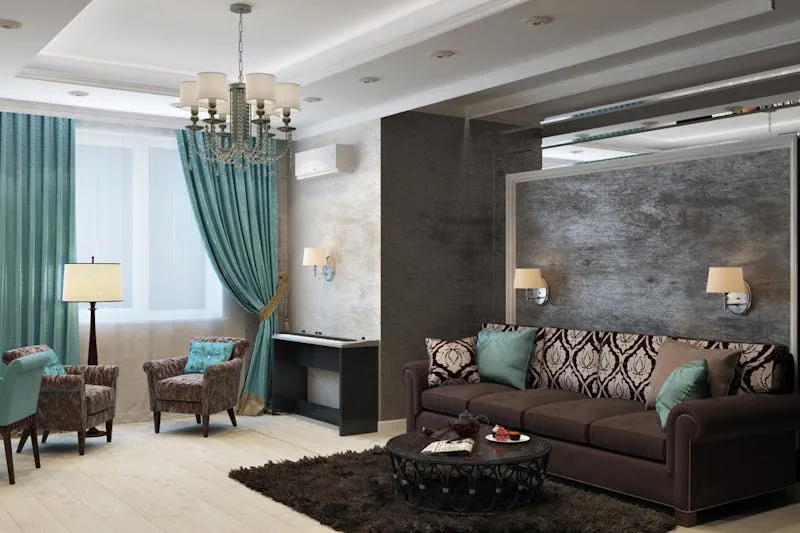
Milan, January 2025. I was dragging my trainers between stands at the Salone del Mobile — the coffee was dreadful, my feet throbbing after six hours on polished concrete — when something clicked: every designer had received the same memo. Everywhere, gentle curves, materials you ache to touch, colours you'd finally dare to put somewhere other than a cushion. Home decor in 2025 is the end of playing it safe.
Yes, every year we're sold "THE" trend that'll revolutionise everything. And every year, half those predictions last about as long as a Christmas tree in January. But this time there's a genuine shift. Not simply terracotta rebranded — a real change in philosophy. Here's the full breakdown, with practical steps so you can take action without gutting your entire flat.
Mocha Mousse: the colour of the year unpacked
Pantone has spoken, and for once nobody rolled their eyes. Mocha Mousse 17-1230 — a warm brown leaning towards caramel — was met with a collective "about time." After 2024's Peach Fuzz (cute but tricky to live with day-to-day), this indulgent brown has the enormous advantage of pairing with absolutely everything.
In practical terms, it's a soft brown — neither too cool nor too warm — that works equally well across an entire wall or layered through textiles. Pantone calls it "sensory comfort" — translation: the colour of your favourite coffee, in paint form. And honestly, it's the first Colour of the Year since 2020's Classic Blue that feels genuinely liveable.
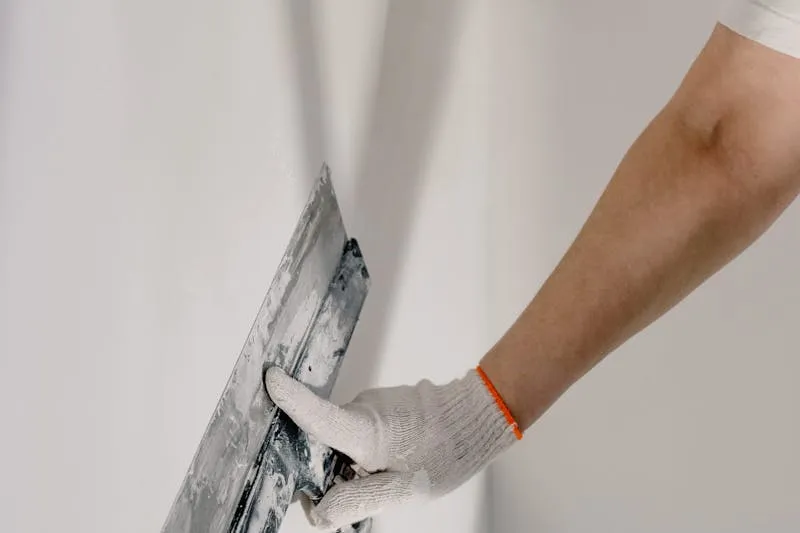
How to use it without going full Cadbury
The Mocha Mousse trap is turning your living room into a chocolate bar. Here are three approaches that work:
- The accent wall: one wall in Mocha, the rest in off-white or cream. It's the safe version, and it's highly effective — especially if that wall sits behind your sofa
- Textile layering: throws, cushions, curtains in shades of brown, caramel and hazelnut. Keep your walls white but let the room bathe in warmth
- The statement piece: a velvet armchair in brown, a walnut coffee table. One strong object rather than colour everywhere
Kristina's tip: If you're unsure about painting a wall, buy a sample pot first (Farrow & Ball and Little Greene do small tester pots) and tape it to the wall with washi tape. Live with it for a week at different times of day. Natural light changes everything — a gorgeous Mocha at 3pm can look dismal at 8pm under spotlights.
Winning combinations
Mocha Mousse loves gentle contrasts. Here are the palettes I've spotted from decorators who actually know what they're doing:
- Mocha + cream + sage: the most natural pairing, very slow-living
- Mocha + petrol blue: unexpected but gorgeous — the deep blue lifts the brown
- Mocha + terracotta + brass: for something bolder, almost Mediterranean
- Mocha + blush pink: soft without being saccharine, perfect for a bedroom
The palettes that actually matter
Mocha Mousse sets the tone, but a single colour of the year doesn't make a trend. Here are the foundational palettes appearing everywhere — from the Milan fair to the feeds of the decorators the world copies.
Enriched earth tones
We're no longer talking about the lone terracotta of 2020-2022. The palette has broadened considerably: clay, golden sand, washed brick, red ochre, burnt sienna. What changes in 2025 is that we dare to mix them together rather than placing a single "accent" against a white wall. The result looks like a Tuscan landscape — and yes, it's every bit as beautiful as it sounds.
Green, still — but differently
Sage green has flooded Instagram since 2022 to the point where it's become the new grey. In 2025 green evolves: deeper shades (forest, moss, dark olive) and sharper ones (chartreuse, apple green). Mid-range green — neither too light nor too dark — is starting to date. Pick your side.
Blue's comeback
After years of warm tones reigning supreme, blue is back with force. Not classic navy (though it remains timeless), but a "washed denim" blue for casual spaces and electric Klein blue for rooms with character. Dutch designers in particular are wild about it this season.
Watch out: Klein blue is magnificent as an accent but unbearable in an entire room. A cushion, a frame, a vase — not a whole wall. The only exception: the loo, where an intense blue creates a "wow" in a space you're only passing through.
Natural materials: the return of the real
If 2025 had a decor slogan, it would be "touch me." Smooth, cold, perfect surfaces are being replaced by textures you want to run your hands over. And not just for aesthetic reasons — though those too. It's a deeper movement tied to our fatigue with all things digital.
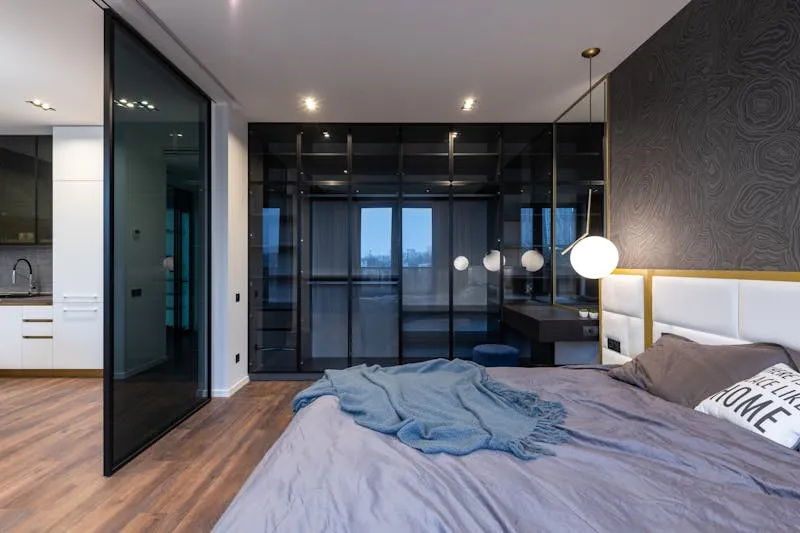
Wood: raw rather than varnished
The lacquered-wood look of the 2010s is done. In 2025 we want to see the grain, feel the texture under our fingertips. Raw oak, oiled walnut, bleached ash — natural finishes are taking over. And if you own a solid-wood piece buried under three coats of varnish, this might be the moment to strip it back. A weekend's sanding, and you've got furniture worth three times its current value.
Natural stone
White marble remains a classic, but 2025 is the year of raw stone: travertine, Burgundy limestone, terrazzo with chunky aggregates. Travertine in particular is everywhere — coffee tables, trays, wall cladding. Its naturally porous surface and tonal variations deliver exactly the "something" that a marble-effect laminate never will.
Textiles with character
Rumpled linen is 2025's undisputed king — but not the "pretending to be crumpled when it's actually polyester" sort. Real linen — the kind that creases, moves, lives. Behind it: bouclé (the pebble texture you either love or loathe), undyed raw wool, thick artisan cotton. And a surprise: corduroy, which nobody saw coming, is making a strong return on seating.
Kristina's tip: Want a "textured" interior without buying new furniture? Start with textiles — they're easy to swap with zero DIY. A raw-linen throw on your sofa, bouclé cushions, thick cotton curtains. One afternoon's shopping and your room has an entirely new personality.
Organic curves and goodbye sharp angles
This trend had been simmering for a few seasons, but in 2025 it's official: right angles are boring. Sofas are rounding out, mirrors going asymmetrical, tables adopting pebble shapes. It's the triumph of what designers call "biophilic design" — forms that mimic nature, where nothing is ever perfectly geometric.
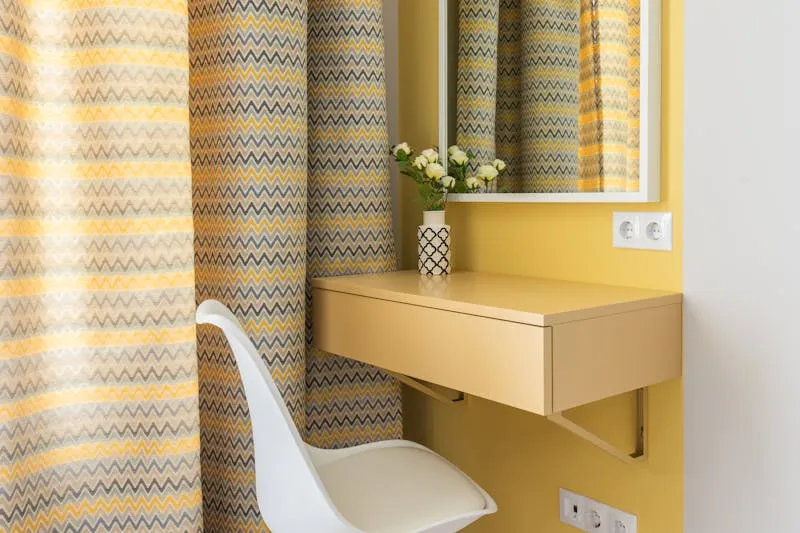
Hero pieces
- The curved sofa: the centrepiece of this trend. "Cloud" and "bean" models dominate catalogues — from Ligne Roset down to more accessible brands like Made.com or Habitat
- The organic mirror: asymmetrical, with undulating edges. The Umbra "Hubba" wavy mirror has become a global bestseller — and costs under £50
- The arch: arch forms are turning up everywhere — bookcases, mirrors, wall niches, headboards. It's gentle geometry at its finest
- The organic coffee table: in travertine, sculpted wood or resin, tabletops resembling sea-smoothed pebbles are everywhere
How to introduce curves into an existing interior
You're not going to bin your Billy bookcase for a £2,000 curved shelf. And that's perfectly fine — the idea isn't to turn your flat into the Guggenheim. One or two organic elements are enough to break the rigidity of a rectangular room. An asymmetrical mirror above your chest of drawers, a free-form vase on your table, a round rug instead of a rectangular one: these small gestures shift the entire dynamic.
Kristina's tip: An organic mirror is probably the smartest buy of 2025. For £40 to £80, you get a statement piece that instantly modernises any wall. Place it in the hallway or above a low unit for maximum impact.
Unapologetic maximalism
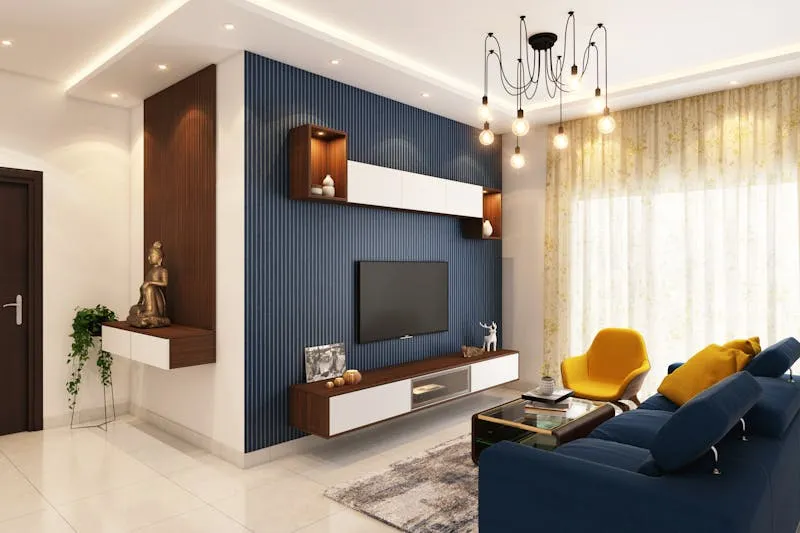
After a decade of Scandi minimalism where a single trinket on a shelf caused cold sweats, the pendulum is swinging back. Hard. Maximalism in 2025 says: layer, mix, dare. But — and this is the crucial nuance — with intention.
Maximalism ≠ mess
The difference between a successful maximalist interior and a car boot sale is coherence. You can have fifteen frames on the wall, three different prints on your cushions and a Persian rug under a brass chandelier — but there needs to be a thread. A shared colour palette. A theme. An intention.
Gallery walls are back with force — but not the pixel-perfect grids of Pinterest 2018. We're mixing sizes, frames, media. Family photos alongside art prints, a vintage mirror in the middle, a ceramic plate that wandered in. The idea is that your wall tells your story, not a catalogue's.
Neo-vintage
2025 confirms the explosion of second-hand in decor. Vintage pieces — 70s armchairs, opaline lamps, 80s rattan furniture — are no longer charity-shop finds but proud centrepieces. And the market has caught on: eBay, Vinterior, Facebook Marketplace's furniture section and Sunday antiques fairs have never been busier.
The winning formula: one or two neutral contemporary pieces (the foundation) plus vintage finds that bring character. Your sofa can be new and understated — it's the green velvet chair you found at Kempton Market that gives the room its soul.
Watch out: Maximalism requires editing. If you accumulate without ever removing, you end up with an oppressive space. The "rotation" rule works well: when a new object arrives, an old one leaves. Not to the bin — into a box, awaiting a future comeback. It prevents the cluttered look while keeping the visual richness.
Kitchen and bathroom: room-by-room trends
The 2025 kitchen
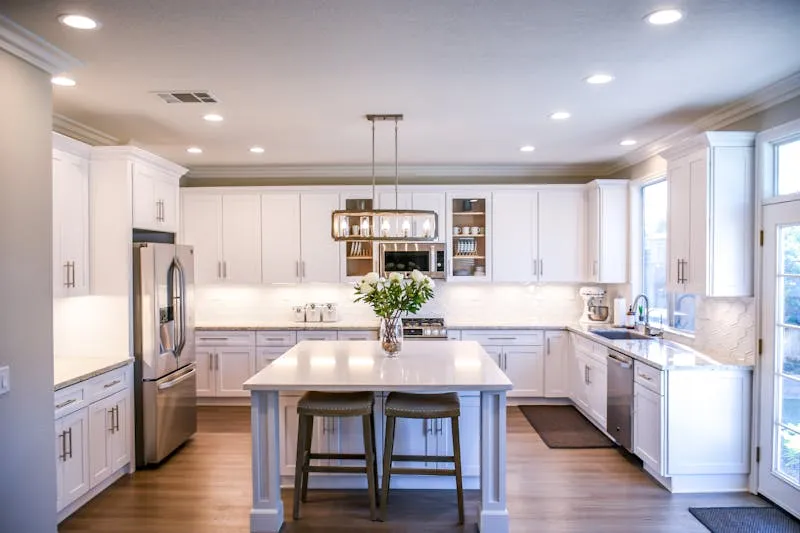
The total-white kitchen has had its day. It's not that it's ugly — it simply became synonymous with "I didn't choose, so I went white." The big moves:
- Natural wood cabinetry: light oak or walnut, kitchen fronts showing their grain. Handles disappear (push-to-open) or become decorative elements in brushed brass
- Stone worktops: black granite is unshakeable, but quartzite and dekton (ultra-compact) are gaining ground for mid-range budgets
- The multi-function island: no longer just a work surface — it's the nerve centre of the home. Integrated seating, hidden storage, USB ports
- Open shelving: not everywhere (let's be realistic — we all have a cupboard of mismatched Tupperware) but on one wall section, to display crockery and jars. Pretty and functional
- Zellige splashbacks: handmade Moroccan tiles continue their takeover. Their irregularities are their charm — every tile is unique
The 2025 bathroom
The bathroom has changed more than any other room in the past five years. From a purely functional space, it's become a genuine wellness retreat. In 2025:
- Tadelakt makes a comeback: this waterproof Moroccan plaster replaces tiles on shower walls. Not the cheapest option, but spectacular
- Brushed brass taps: chrome is officially passé. Brushed brass, matt black or brushed gold — warm finishes dominate
- Stone basins: set on a wooden unit, they transform any standard vanity into a designer piece
- XXL walk-in showers: smoked glass panels replace clear ones — more intimate, more elegant
- Plants: ferns, pothos, orchids — the bathroom is becoming a tropical greenhouse
Kristina's tip: The highest-impact, lowest-cost bathroom change? Taps. Swapping a chrome mixer for a brushed-brass model costs between £60 and £150 and takes an hour. The effect is immediate — everything else in the room looks more "intentional."
The cocooning bedroom, 2025 edition
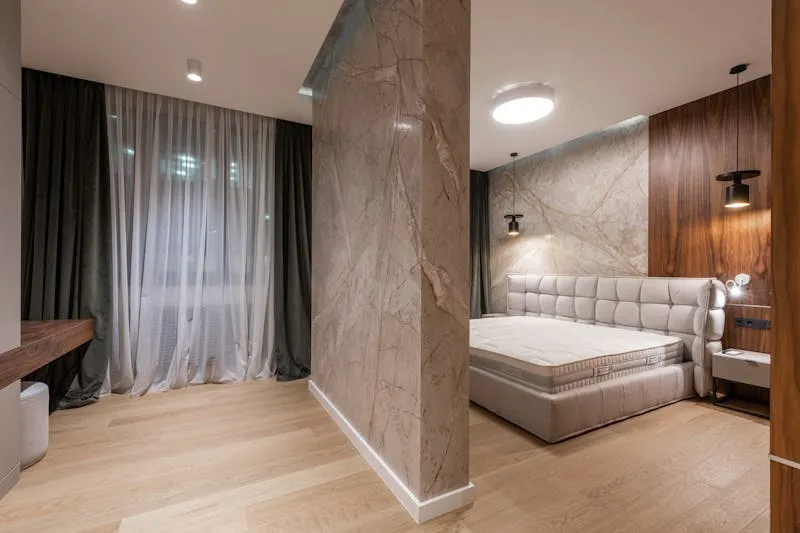
The bedroom is where 2025 trends make the most sense. After years of screens in bed and midnight scrolling, the "sleep-centric design" movement is gaining real momentum. The principle: your bedroom is a sanctuary, not an extension of your desk.
The textile headboard
The tufted velvet headboard had its moment. In 2025, we're moving to linen, bouclé, more relaxed natural textures. XXL headboards — running right up to the ceiling — create a spectacular cocooning effect. Bonus: they improve the room's acoustics too.
Layered lighting
Bedroom lighting mistake number one: a single ceiling pendant as your only source. In 2025, we layer: ambient light (fairy lights or indirect LEDs), wall-mounted reading lights on each side of the bed, and possibly a floor lamp in the reading corner. The ceiling light exists purely for locating your socks in the morning.
The "cloud" bed
The term is all over TikTok, and behind the buzz there's a genuine trend. The idea: a bed so enveloping, plush and layered that you feel like sleeping on a cloud. In practice, that means a quality mattress topper, a natural-down duvet (not polyester), pillows in unreasonable quantities, and bed linen in percale or washed linen.
The budget can escalate quickly — a natural-latex topper runs £150 to £400 — but it's an investment in health as much as aesthetics. You spend a third of your life in bed. It's the one place where spending more makes the most sense.
Watch out: Social media shows "cloud" beds with twelve perfectly arranged pillows. In reality, you remove eight every night and toss them back each morning. Match the number to your actual patience — four pillows is plenty for the visual effect without the daily chore.
Sustainable decor: from greenwashing to real commitment
Every brand tells you it's "eco-responsible" in 2025. It's become a marketing checkbox, making it increasingly difficult to separate genuine commitment from green paint (literally). Here's how to tell the difference.
Labels that matter
In furnishing, reliable labels are rare but precious:
- FSC (Forest Stewardship Council): for wood — the only credible forestry certification
- OEKO-TEX Standard 100: for textiles — guarantees no harmful substances
- GOTS (Global Organic Textile Standard): for organic cotton and linen — the global benchmark
- EU Ecolabel: for paints and coatings — strict VOC criteria
Second-hand as a design statement
Buying pre-owned isn't "making do" any more — it's an assertive design choice. A 1960s teak sideboard found on Vinterior for £200 is simultaneously more beautiful, more solid and more sustainable than its new equivalent at £400. And it has a story — which in 2025 is the most luxurious thing an object can offer.
Platforms to know: Vinterior (curated, pricier but reliable), eBay (the deep end — you'll need to filter), Facebook Marketplace (booming), physical antiques fairs (Kempton, Ardingly, Sunbury). And charity furniture shops — often overlooked treasures where you'll find solid-wood pieces for next to nothing.
Recycled materials that no longer look recycled
Recycled-glass terrazzo, ocean-plastic worktops, regenerated-fibre textiles — these materials have made enormous aesthetic progress. Recycled PET transformed into soft velvet is now virtually indistinguishable from the conventional version. The difference shows on the label, not the touch.
Adopting trends without breaking the bank
A trendy interior isn't one that cost £20,000. It's one that was thought through. Here's the realistic action plan — the one I give friends who ask how to "modernise" their flat without emptying it.
Three investment tiers
Tier 1 — Under £80 (instant impact):
- Swap your cushions — 4-6 linen or bouclé covers in trend colours: £30-60
- An organic mirror: £25-50
- A handmade ceramic vase: £10-30
- Replace cabinet handles with brushed brass: £15-40
- A few candles in design-forward holders: £10-25
Tier 2 — £150 to £400 (visible transformation):
- Paint an accent wall in Mocha Mousse: £40-80 (paint + supplies)
- A statement light fitting: £60-150
- A quality wool or linen throw: £50-120
- Change the bathroom taps: £60-150
- A vintage armchair (second-hand): £80-250
Tier 3 — £800 to £2,500 (metamorphosis):
- A curved-line sofa: £600-1,600
- Re-floor a room in hardwood or travertine: variable
- Partial kitchen refresh (fronts + worktop): £800-2,500
- Bespoke linen curtains for the whole flat: £400-1,200
Mistakes to avoid
After ten years of watching trends and following a few (with occasional regrets), here are the traps I'd steer you around:
- Buying a trendy sofa: a sofa is 10 to 15 years of your life. Choose a timeless shape and use textiles to chase trends
- Doing everything at once: an interior built gradually always has more personality than a flat overhauled in a single weekend
- Following a trend you don't like: maximalism gives you hives? Stay minimal. Trends are a menu, not a set meal
- Ignoring your room's architecture: a curved sofa in a narrow 18 m² room won't work. Trends must adapt to your space, not the reverse
Kristina's tip: List everything you already own and genuinely love. Seriously — take ten minutes and write it down. You'll probably realise you already have about 70% of the foundation. The rest is accessorising and styling. Interior design is 30% shopping and 70% arrangement.
Frequently asked questions about 2025 decor trends
Is white "outdated" in 2025?
Absolutely not. White remains a timeless base and nobody should repaint their white walls out of fear of being "out." What's shifting is pure brilliant white giving way to warmer tones — off-white, cream, linen white. And the notion that an all-white interior is "the standard" is, yes, well and truly passé.
Are 2025 trends budget-friendly?
Yes, and that's actually one of their strengths. Natural materials can be found second-hand, colours cost only a tin of paint, and maximalism encourages mixing rather than buying sets. A trend-forward 2025 interior can absolutely be built with £150 and some time.
Is the Scandinavian style dead?
Pure "Scandi" — white walls, pale wood, one plant, done — has indeed lost its dominance. But Scandinavian fundamentals (functionality, natural light, quality materials) remain solid foundations. What's evolving is the addition of colour, texture and personality to that base — an "enriched Scandi" rather than a total departure.
Is terrazzo coming back or going out?
The "2019 terrazzo" (small pastel chips on a white base) has had its day. 2025 terrazzo is different: large aggregates, bolder colours, recycled materials. It remains relevant in small doses — a tabletop, a splashback — but as a total floor covering, it's starting to date.
How do I mix trends without creating a "catalogue" interior?
The key: choose one strong trend as your thread — say, organic curves — and let the others appear as secondary accents. An interior that tries to tick every trend box ends up looking like a showroom. One that picks a single direction and commits to it has personality.
Should I follow trends or ignore them?
Trends are inspiration, not obligation. If you're happy in your current space, change nothing. If something feels missing or you're bored, trends offer leads — but the only trend that never goes out of style is an interior that feels like you.